Views: 1 Author: ZZKNOWN Editorial Team Publish Time: 24-09-2026 Origin: ZZKNOWN


Published: September 24, 2026 | Last Updated: September 24, 2026 | Reading Time: 16 minutes
Direct answer: Store cleaners, sanitizers, pesticides and maintenance chemicals in a dedicated, secured, leak-resistant area where a spill cannot reach food, utensils, linens or packaging. Give employee bags, coats, phones and medicines a different designated locker or compartment. In a small food trailer, the safest layout usually uses two clearly separated storage zones—not one “miscellaneous” cabinet under the prep counter.
Plan two separate zones. Chemical storage and employee belongings solve different risks and should not share a catch-all cupboard.
Store chemicals below and away from food. A leak should not drip onto ingredients, equipment, utensils, linens or single-use packaging.
Keep every working container identifiable. An unmarked spray bottle is a preventable mistake, even when its contents seem obvious to the person who filled it.
Restrain mobile loads. Doors, latches, shelves and bottles must remain secure during towing, braking and uneven-road movement.
Do not forget personal items. Jackets, backpacks, phones, keys and medication need a designated location outside exposed-food and clean-equipment zones.
Confirm local rules before fabrication. The FDA Food Code is a model in the United States; the EU and Australia use different legal frameworks and local enforcement.
Where and when does this guide apply? This article is written for global buyers planning a food trailer for the United States, European Union, Australia or another destination market. Official sources and live ZZKNOWN product pages were reviewed on September 24, 2026. It is a procurement and layout guide, not legal advice, a chemical compatibility assessment or a guarantee of permit approval.
Imagine the first morning in a new burger trailer. The stainless counters are polished, the refrigerator is cold and the team is ready. Then one employee places a backpack on the dry-storage shelf. Another sets an unmarked blue spray bottle below the hand sink. A spare bottle of degreaser goes on top of a box of takeaway cups because every cabinet already looks full.
Nothing dramatic has happened, but three avoidable risks have appeared before the first order. The problem is not that the trailer lacks storage. The problem is that nobody assigned a safe home to the things that do not belong with food.
Based on CNREALLY KNOWN’s production experience, buyers often spend hours comparing fryers, refrigerators and serving windows, yet leave chemicals, employee possessions and maintenance supplies until the last revision. We are describing a common design-review pattern—not inventing a customer incident or claiming personal experience. The fix is simple when it happens in CAD and much less convenient after every cabinet has been fabricated.
Start by listing what the team will actually bring and use. “Cleaning cabinet” is too vague. A working trailer may carry detergent, sanitizer, disinfectant, degreaser, glass cleaner, descaler, pest-control products, test strips, wiping-cloth solution, disposable gloves, a first-aid kit, personal medication, maintenance lubricant, hand tools, spare bulbs, employee coats, bags, phones and paperwork.
Those items do not all belong together. Some can leak, release fumes or be misused. Some may carry dirt and microorganisms from outside. Others are clean maintenance parts that still should not land on a food-preparation surface. Divide the list into storage classes before deciding cabinet size.
Storage class | Typical examples | Preferred planning approach |
|---|---|---|
Cleaning and sanitizing chemicals | Detergent, sanitizer, disinfectant, degreaser | Dedicated cabinet or compartment; restrained, labeled and separated from food |
Pest-control or other restricted products | Approved pesticide or bait used by authorized persons | Carry only when needed and lawful; secure according to label and local rules |
Employee belongings | Coats, bags, phones, keys and shoes | Separate locker, cubby or closed cabinet outside exposed-food zones |
Medicines and first aid | Personal medication, bandages and first-aid supplies | Identified and protected; follow special rules for refrigerated medicine |
Maintenance items | Tools, screws, lubricant, paint and spare parts | Dedicated box or service compartment, away from food and clean utensils |
Office and operating materials | Laptop, pens, receipt rolls and paperwork | Clean drawer or cabinet away from active food preparation |
This inventory is the beginning of a real design brief. Count the number and size of chemical containers. Ask how many employees will work at once. Decide whether staff change clothes inside the unit. Note whether any medicine needs refrigeration. A two-person coffee trailer and a six-person festival kitchen may need very different personal-storage capacity even when both use the same sanitizer bottle.
Because gravity is predictable. A loose cap, cracked trigger, overfilled bottle or leaking container can contaminate whatever sits below it. The newest 2026 FDA Food Code, section 7-201.11, requires poisonous or toxic materials to be stored so they cannot contaminate food, equipment, utensils, linens, or single-service and single-use articles. It describes separation by spacing or partitioning and storage that prevents leakage or spillage onto those protected items.
The same chapter does more than discuss shelf position. Section 7-101.11 addresses identifying information on original containers, while section 7-102.11 requires working containers holding products such as cleaners, sanitizers and disinfectants to be individually identified with the common name. Section 7-202.11 limits the presence of toxic materials to those required for operation and maintenance. Section 7-202.12 ties use to law and the manufacturer’s label.
Important U.S. update: FDA released the 2026 Food Code in September 2026, making it the current full edition at the time of this review. FDA describes the Food Code as a model for state, local, tribal, territorial and federal jurisdictions. The operating authority—not the exporter—decides which edition and local rules apply to your trailer.
A dedicated chemical cabinet does not need to be complicated, but it needs to be deliberate. A low cabinet can reduce the consequence of a leak onto food above, yet “under the sink” is not automatically safe. Check whether water pipes, pumps, electrical components, spare paper goods or a water heater share the space. Do not create a cabinet where a plumbing leak wets chemical labels, where chemicals corrode equipment, or where service technicians must remove hazardous bottles to reach a pump.
Think about normal operation and road movement. In a fixed restaurant, a bottle may stay where it is placed. In a trailer, it experiences acceleration, braking, vibration and turns. A cabinet door that looks fine in the showroom can open on the road if its latch is weak. A tall bottle can tip if shelf height and restraint are not planned.
Ask the engineer about a positive latch, corrosion-resistant and cleanable internal surfaces, a removable containment tray where compatible with the chemicals, bottle restraint, usable shelf height, access for cleaning and a location that does not interfere with heat-producing equipment. Confirm chemical compatibility using the product label and safety data sheet. Stainless steel, plastic trays, seals and coatings do not react identically to every concentrated chemical.
Cabinet parameter | What to confirm | Why it matters in a trailer |
|---|---|---|
Door retention | Positive latch; no accidental opening | Braking and vibration can release ordinary doors |
Internal height | Measure the tallest approved container plus handling clearance | Bottles stored sideways leak more easily |
Secondary containment | Removable, cleanable tray sized for the planned products | Helps confine minor leakage and simplifies cleaning |
Separation | No food, cups, packaging, linens or utensils in the same risk zone | Protects against drips, spills and handling mistakes |
Service access | Cabinet can be emptied and cleaned without dismantling equipment | Hidden corners become neglected during daily cleaning |
Identification | Original labels remain legible; working containers show common names | Prevents a spray bottle from being mistaken for water or food ingredient |
Do not present this table to an inspector as a universal specification. It is a buyer’s review list. Local fire codes, occupational-safety rules, pesticide controls and chemical manufacturer instructions may add other requirements. Flammable products, compressed gas and large chemical quantities may need specialized storage beyond an ordinary food-trailer cabinet.
Because personal belongings arrive from outside and get handled repeatedly. A bag can sit on a car floor. A coat can brush against a wall or restroom surface. A phone moves between hands, counters and pockets. These items do not belong on a prep table, above clean cups or beside uncovered ingredients.
The FDA Food Code addresses employee possessions in more than one place. Section 6-305.11 calls for lockers or other suitable facilities for the orderly storage of employee clothing and possessions. Section 6-403.11 places those facilities in a designated room or area where contamination of food and protected items cannot occur. Section 7-209.11 covers personal-care items; the annex explains that such items can contaminate food, equipment and food-contact surfaces when not properly labeled and stored.
“Locker” does not always mean a tall school-style metal locker. In a compact trailer, it can be a closed upper compartment near the staff entrance, a bank of small cubbies with doors, or a clean cabinet separated from food and chemical storage. The right answer depends on staff count, belongings, shift length and whether clothing changes happen in the trailer.
Avoid a locker directly over an open prep table. A jacket sleeve, loose key or dusty bag should not pass over ready-to-eat food every time an employee starts or ends a shift. Also consider charging cables: a phone-storage point should not create a dangling cord across a walkway or consume an outlet planned for kitchen equipment.
Do not throw them into the same bin as receipt paper or cleaning chemicals. FDA Food Code section 7-207.11 limits medicines in a food establishment to those needed for employees or certain authorized uses and requires labeling and storage to prevent contamination. Section 7-208.11 addresses identification and storage of first-aid supplies. If employee medicine requires refrigeration, section 7-207.12 describes storage in a covered, leakproof container that cannot contaminate food.
For a real operation, assign responsibility. The operator should decide who controls the first-aid kit, how refrigerated medicine is isolated if local rules permit it in the food refrigerator, and how privacy is protected. The trailer manufacturer can provide a location or compartment; the operator and local authority define the procedure.
Start with the staff entrance and workflow. Personal storage is often most useful near the entrance so an employee can put away a bag or coat before entering the main preparation path. Chemical storage is often most useful near the cleaning or warewashing area—but not where it can leak onto clean drainboards, food, packaging or electrical components.
Test every door in CAD. Open the refrigerator, chemical cabinet, personal locker and entry door at the same time. Can two workers still pass? Does the chemical door block the hand sink? Does the locker door swing over an open fryer? Can a cleaner be removed without carrying it over a food-prep surface? These are simple geometry questions that become daily operational problems if ignored.
Possible location | Best use | Main tradeoff to review |
|---|---|---|
Closed upper cabinet near staff entrance | Bags, jackets, phones and keys | Must not be above exposed food or hot equipment |
Low cabinet near warewashing | Daily detergent and sanitizer | Protect clean drainboards, plumbing and electrics from leaks |
External service compartment | Bulk backup chemicals or maintenance supplies when locally acceptable | Weather sealing, security, road restraint and access |
Drawer beside POS area | Clean office supplies and receipt rolls | Do not turn it into mixed personal and chemical storage |
One compact cabinet can sometimes be internally divided with sealed, independent compartments, but do not assume a thin shelf creates legal or practical separation. Send the sectional detail to the local reviewer. If staff belongings are on one side and chemicals are on the other, both doors, seams and spill paths matter.
The common objective is to prevent contamination. The wording and enforcement path differ. A global buyer should give the manufacturer an operating location early, instead of asking for a vague “international standard” cabinet.
Market | Official baseline relevant to storage | Buyer action before fabrication |
|---|---|---|
United States | 2026 FDA Food Code Chapters 6 and 7 cover employee facilities, toxic materials, medicines and personal-care items | Check the adopted state/local code and mobile-unit plan-review checklist |
European Union | Regulation (EC) No 852/2004 requires hygienic design and says cleaning agents and disinfectants must not be stored where food is handled | Ask the national/local competent authority how it applies to mobile premises |
Australia | FSANZ Standard 3.2.3 clause 15 calls for adequate storage for contamination sources including chemicals, clothing and personal belongings | Confirm the proposed storage and operation with the local council |
For the EU, see the official Regulation (EC) No 852/2004, including Annex II requirements for movable premises and the rule that cleaning agents and disinfectants are not stored in areas where food is handled. For Australia, Safe Food Australia explains that “adequate” storage depends on the operation and staff count; a designated cupboard may suit a small business, while businesses where staff change clothing may need lockers or a dedicated change area.
Do not turn these comparisons into claims that one cabinet is automatically “FDA approved,” “CE certified” or “Australia compliant.” Food hygiene approval concerns the whole unit, its destination, menu, equipment and operating procedures. CE marking, where relevant to specific equipment or systems, is not a substitute for the local food-business approval process.
Use real dimensions and cabinet layouts as a conversation starter, not as a universal template. The ZZKNOWN KN-FS500 5-meter food trailer lists stainless countertops with cabinets underneath, an under-sink storage cabinet, a pull-out trash bin and a built-in cash drawer. Its published size is 5000 × 2000 × 2300 mm. That makes it a useful example for asking which cabinet serves food, which serves chemicals, and where employee belongings should go—but the product page does not by itself assign every cabinet to those uses.
The KN-FS410 4.1-meter stainless-interior food trailer is another real reference for balancing sinks, tanks, worktops and storage in a smaller footprint. When discussing either model, ask for a marked plan that labels CHEMICALS, PERSONAL ITEMS, FOOD, CLEAN UTENSILS and MAINTENANCE. Labels on a drawing force the hidden assumptions into the open.
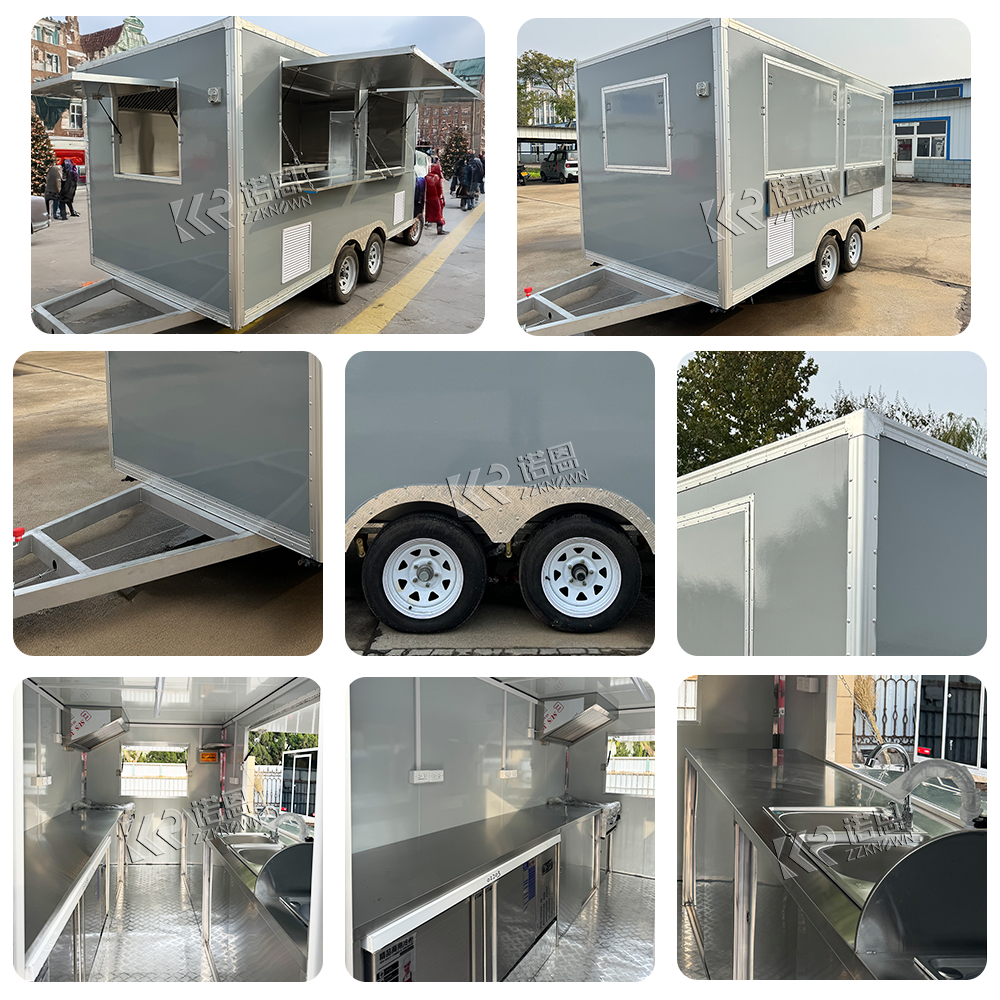
Real ZZKNOWN project image: cabinet doors and work zones should be reviewed on the actual floor plan. This photo is a product reference, not proof that a particular cabinet has been approved for chemical storage.
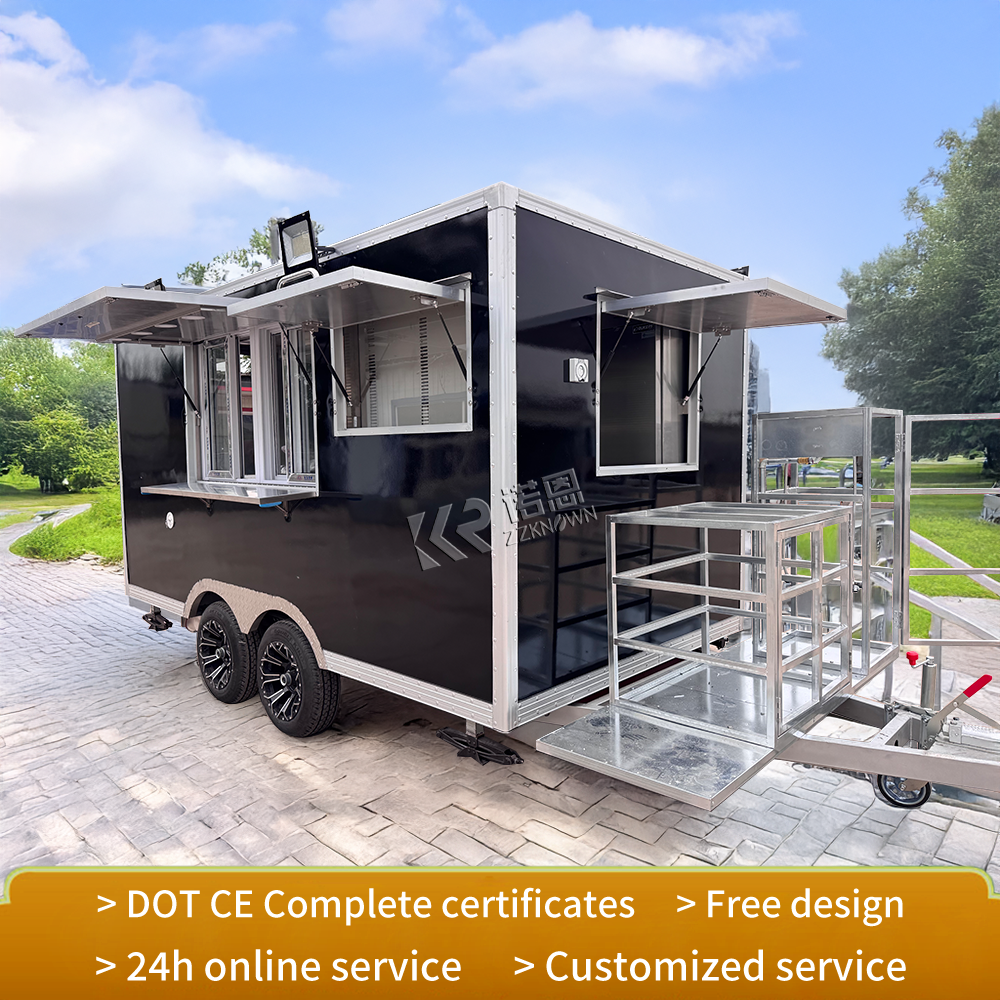
Real ZZKNOWN burger-trailer image: compact cook lines leave little room for improvised storage. Mark personal and chemical zones before equipment positions are frozen.
Engineer’s note: Based on CNREALLY KNOWN’s production experience, a useful request is not “add storage.” It is “provide storage for four employee bags, two coats, six daily-use chemical bottles, one sealed backup container and a first-aid kit, with no shared food-storage volume.” That description can be checked against the available wall length, door swings, tow loads and cleaning access.
Send the factory the operating city, menu, staff count, maximum chemical container dimensions, safety data sheets for unusual products, appliance list and local plan-review notes. Ask the factory to return a dimensioned elevation and floor plan showing cabinet material, door direction, latches, internal clearance, separation, spill path and what sits above and beside each compartment.
Then perform a “road plus rush” review. During towing, can bottles tip or doors open? During service, can staff reach sanitizer without passing it over food? Can an employee retrieve a phone without leaning over the prep counter? Can the chemical cabinet be cleaned if a bottle leaks? Can a technician reach the pump without placing chemicals on the floor? A good cabinet is not merely empty volume; it supports controlled behavior.
Data collection method: We reviewed the FDA’s 2026 Food Code page, the full 2026 PDF and its summary of changes; the official consolidated text of Regulation (EC) No 852/2004; and FSANZ’s Safe Food Australia material available on September 24, 2026. We compared those sources with live ZZKNOWN/ARTEX product pages for the KN-FS500 and KN-FS410 and with published ZZKNOWN project images. Regulatory statements are separated from engineering recommendations. No permit approval, chemical compatibility result, buyer testimonial or project outcome was invented.
Author: ZZKNOWN Editorial Team. Technical review: CNREALLY KNOWN Engineering Department. Final storage design must be reviewed against the actual chemicals, equipment, destination rules and authority having jurisdiction.
Sometimes that location may be workable, but it is not automatically safe. Check plumbing leaks, electrical parts, clean drainboards, stored packaging, access and spill containment. Ask the local reviewer to approve the labeled layout.
Do not plan a shared open space. Personal items can be contaminated by leakage and can also introduce dirt into the chemical-handling area. Provide distinct compartments or separate cabinets, and confirm that the physical separation is acceptable locally.
In the FDA Food Code model, a working container holding a toxic material such as a cleaner, sanitizer or disinfectant must be clearly identified with its common name. Keep the original product directions and safety information available as required by workplace rules.
That is poor practice and may conflict with applicable rules because a spill can contaminate the packaging or its contents. Store chemicals so leakage cannot fall onto food, utensils, linens or single-use items.
Use a designated clean personal-item locker or compartment away from exposed food and clean equipment. Add charging only if the electrical plan and cable routing are safe and do not compete with kitchen circuits.
Only under the rules that apply to the operation. The FDA model allows certain refrigerated employee medicines when stored in a covered, leakproof container that cannot contaminate food. Confirm the procedure with the local authority and protect employee privacy.
The exact requirement varies. A lock may be appropriate for security, but a positive travel latch and prevention of unauthorized access are separate questions. Consider staff access, children or customers near the unit, the product label and local safety rules.
No. Approval depends on the whole trailer, the destination code, chemicals carried, menu and operating procedures. Use the cabinet drawing as part of a complete plan-review submission before fabrication.
Open your current floor plan and mark five categories: food, clean utensils and packaging, chemicals, employee belongings, and maintenance supplies. If any cabinet is marked with more than one incompatible category, stop and redesign it before production. Then list the real container dimensions and staff count so the solution is sized for the operation instead of a brochure photograph.
Want a storage layout built around your menu and destination?
Send ZZKNOWN your target city, menu, staff count, equipment list, chemical-container sizes and current floor plan. Ask for a dimensioned CAD layout that separates chemicals, employee belongings, food, clean utensils and maintenance items. We can prepare design options and an itemized quote; your local authority must confirm acceptance.
Request a cabinet-zoning layout and quote →
Continue planning with these ZZKNOWN guides: handwash-sink placement and splash protection, three-compartment sink sanitizing station design, wall and ceiling material selection, and the pest-proof trailer design guide.