Views: 6 Author: ZZKNOWN Publish Time: 28-08-2026 Origin: ZZKNOWN


ZZKNOWN Engineering Guide
Published: August 28, 2026 | Last Updated: August 28, 2026
Author: ZZKNOWN Editorial Team | Technical Review: ZZKNOWN Mechanical & Kitchen Layout Engineering Team
Direct answer
A food trailer is pest-proofed by controlling every opening, not by spraying more chemicals. Use tight-closing service windows, self-closing doors, cleanable screens or a correctly selected air curtain, sealed pipe and cable penetrations, balanced ventilation, covered waste, and a written inspection routine. The final combination must match the menu, climate, operating hours, and rules adopted by the local health authority.
A large service window can work, but it needs a plan for the minutes when it is open.
Closing speed, gasket contact, screen cleanability, and staff habits matter as much as the opening dimensions.
In the U.S. FDA Food Code, 16-mesh-per-inch screening is one listed method for certain open windows and doors; local adoption and exceptions must be checked.
An air curtain is equipment, not a magic invisible wall. It must be sized, positioned, commissioned, and kept clean.
Strong exhaust without adequate replacement air can pull outdoor air—and insects—through small gaps.
Utility penetrations, drains, roof openings, waste storage, and lighting can undermine an otherwise good service-window design.
Ask the local authority to review the layout before production, because approval happens at the destination, not at the factory.
This guide is written for buyers planning mobile food units in North America, Europe, the United Kingdom, Australia, New Zealand, the Middle East, and other export markets. Sources and product information were checked on August 28, 2026. The design principles are broadly useful, but the cited rules are jurisdiction-specific. Your city, county, state, province, council, venue, fire authority, and pest-control program may add or change requirements.
Picture the first warm evening at a new food festival. The trailer looks excellent, the menu board is bright, and the service window is wide enough for two people to hand out orders. Then the fryer and grill start, the exhaust fan pulls hard, the outside lights come on, and flies begin circling the opening. The operator's first thought is often, “I need a stronger pesticide.” The better question is, “Where did our design and routine create an invitation?”
Based on CNREALLY KNOWN's production experience, pest problems are rarely caused by one dramatic hole. They usually come from several ordinary details working together: a door that does not latch, a sliding pane left open between customers, a cable penetration with a small gap, a dirty screen, uncovered syrup near a waste bin, or negative pressure caused by an exhaust system that has no adequate make-up air.
Pest-proof does not mean that no insect will ever enter. A trailer operates outdoors, often at beaches, night markets, fairgrounds, farms, and humid summer events. The practical goal is to prevent entry where reasonably possible, remove attractants, protect exposed food, detect activity early, and correct the cause quickly.
That turns pest control into a system with four layers:
Exclude: close, screen, seal, or protect openings.
Reduce attraction: control food residue, standing water, waste, grease, and poorly placed lighting.
Monitor: inspect known entry points and keep treatment records when required.
Correct: repair gaskets, adjust closers, clean screens, rebalance airflow, and use approved professional treatment when necessary.
This is also why a pest-proof package should appear on the CAD drawing and technical checklist—not only in an operating manual received after the trailer arrives.
Region | Official source | Useful design message | Important limit |
|---|---|---|---|
United States | FDA Food Code 2022, especially §6-202.15 and §6-501.111 | Close holes and gaps; use tight-fitting windows and self-closing, tight-fitting doors. For certain open windows or doors, listed protections include 16-mesh-per-inch screens, properly designed air curtains, or other effective means. | The Food Code is a model. States and local authorities adopt and amend it differently. |
European Union | Regulation (EC) No 852/2004, Annex II | Movable premises should be designed and maintained, as far as reasonably practicable, to avoid contamination, particularly by animals and pests. Where necessary, openable outside windows are fitted with removable, cleanable insect-proof screens. | National and local enforcement details still matter. |
Australia / New Zealand | FSANZ mobile food business guidance and pest-control guidance | Protect food from pests, use mesh screens/weather strips, self-closing doors or air curtains where appropriate, seal pipe and wire openings, and manage waste. | Notify and consult the relevant local council; operational and fit-out expectations vary. |
For U.S. projects, start with the FDA text but ask the authority having jurisdiction which edition and mobile-unit provisions it uses. For EU projects, do not read the fixed-premises window sentence in isolation; Annex II Chapter III specifically addresses mobile sales vehicles. For Australia and New Zealand, FSANZ guidance repeatedly points mobile operators back to the relevant council. That is why ZZKNOWN treats official review as a buyer-side project milestone rather than a factory-issued blanket promise.
Walk around the trailer as if you were a fly looking for warm air, aroma, light, moisture, and food. The obvious opening is the serving window, but it is only one line on the inspection sheet.
Serving windows: sliding panes, lift-up hatches, order windows, pickup windows, pass-through gaps, and worn brush seals.
Personnel doors: lower sweeps, thresholds, hinge-side gaps, latch-side compression, vents, and doors held open during loading.
Ventilation openings: fresh-air inlets, roof vents, louvered panels, and spaces around hood or air-conditioning penetrations.
Utility penetrations: water fills, waste outlets, shore-power cables, gas lines, drain hoses, data wiring, and future appliance holes.
Body joints: floor-to-wall transitions, wheel boxes, panel joints, damaged sealant, and unclosed fabrication access holes.
Operating zones: waste bins, syrup stations, exterior condiment tables, wet mats, and cartons stored beneath the trailer.
A useful commissioning test is simple: close the doors and windows in daylight, darken the interior, and inspect the perimeter for visible light. That does not replace a formal inspection, but it quickly reveals many missed gaps. Repeat it after transport, because vibration and body movement can change door alignment.
Start with the menu and transaction flow, not a catalog window size. A coffee trailer that hands out one cup at a time may need a different opening from a festival burger trailer that separates ordering and pickup. The smallest opening that safely supports the workflow is generally easier to protect, condition, and close.
Good questions for the drawing review include:
Will staff close the pane between transactions, or is the window expected to stay open for hours?
Can a removable screen stay in place while orders pass through, or does it block the handoff?
Is a separate small transaction opening possible inside a larger display hatch?
Can the screen frame be removed without tools and washed away from exposed food?
Where will the air curtain mount, and will the hatch, awning, menu board, or lighting interrupt its discharge?
Does the serving shelf drain and clean easily, without creating a protected ledge for residue?
The ZZKNOWN 4-meter mobile lemonade trailer is a real example of a high-throughput beverage layout with a large glass sliding service window. It illustrates the design tradeoff clearly: a wide opening supports busy service, but a buyer in a high-insect area should add an explicit close-screen-airflow plan before approving the final drawing.
Option | Planning parameter | Best use | Main limitation | Relative cost impact |
|---|---|---|---|---|
Tight-closing sliding pane | Full perimeter contact; adjustable rollers/latch | Closing between orders | Protection disappears when left open | Low |
Removable insect screen | FDA example: 16 mesh/inch where locally applicable | Ventilation openings or service periods with limited handoff | Reduces airflow; collects dust and grease; can obstruct service | Low–medium |
Commercial air curtain | Opening width, mounting height, discharge direction, verified insect-control rating | Open, high-frequency transaction windows | Needs power, cleaning, correct selection, and balanced air | Medium–high |
Small pass-through within a larger hatch | Transaction aperture matched to product | Night events and quick handoff | Needs staff discipline and custom framing | Medium |
Layered window package | Pane + removable screen + approved air curtain, selected by risk | Hot, humid, high-volume or night operation | More coordination, maintenance, and budget | High |
These are comparison categories, not installed-price quotations. Final cost depends on opening size, frame material, local certification, controls, voltage, freight, and whether the item is factory-integrated or added later.
For a real equipment reference, Berner lists purpose-built concession and drive-through models such as the DTU03 Drive-Thru Unit 3 and SLC07 sanitation-certified series. Mentioning a real model does not mean it is automatically suitable or approved for every trailer. The opening width, installation position, local listing expectations, electrical supply, and food-service environment still need review.
Engineer note: If a drawing shows an air curtain but does not show its mounting height, discharge path, power circuit, service clearance, and relationship to the exhaust/make-up-air system, the design is not finished. Select the unit from its manufacturer data and verify performance after installation. Do not assume that any fan above a window qualifies as an insect-control air curtain.
A hood removes hot, greasy air. That air must be replaced. If the trailer exhausts more air than it receives through planned inlets, the interior falls below outdoor pressure. Air then rushes through the easiest available route: a door sweep, window track, pipe opening, or unsealed panel joint. Flying insects can follow that flow.
This is one reason window planning cannot be separated from ventilation planning. Read our food trailer ventilation system guide before freezing the hood, fan, make-up air, air-conditioning, and service-window layout. For electric equipment and a powered air curtain, also review the food trailer electrical system guide and equipment power consumption guide.
During commissioning, test the trailer in realistic operation: cooking equipment on, hood at operating speed, air conditioner running, doors closed, and the service window in its normal service position. A design that seems fine in an empty workshop may behave very differently during a dinner rush.
A good personnel door is solid, close-fitting, easy to clean, and able to close without a worker pulling it shut. Check the closer, latch, hinges, perimeter gasket, threshold, and lower sweep as one system. A thick sweep does not help if the latch-side corner stays open.
Door hardware also needs to survive trailer movement. After a long delivery or frequent towing, inspect alignment again. Fasteners may settle, a closer may need adjustment, or a gasket may compress. Make gasket and sweep replacement possible without removing the entire door frame.
Do not create a new hazard while solving pests. Emergency egress, fire rules, access width, and door swing remain important. The competent authority should approve the final door arrangement, especially if a door is designated as an emergency exit or the layout includes LPG and high-heat equipment.
Every service that crosses the trailer envelope needs a deliberate detail. A rough hole around a pipe is difficult to clean, admits insects and water, and can abrade the service during transport. Depending on the system, a proper detail may use a grommet, collar, boot, gland, escutcheon, durable sealant, or mechanically protected sleeve.
The key is to seal the unwanted space while preserving the function and serviceability of the component. Do not seal required ventilation, pressure relief, drainage, combustion air, or access points. Do not bury a joint that technicians must inspect. Ask for a penetration schedule on the drawing: what crosses the wall or floor, where it is located, how it is protected, and how it can be cleaned.
FSANZ's Safe Food Australia guidance specifically discusses sealing openings where pipes pass through external walls and avoiding pest harbourage around gaps and crevices. That principle is useful globally even though the legal document applies in its own jurisdiction.
Yes. Even an excellent window system struggles when attractants are placed beside it. Keep sticky beverage residue, uncovered garnishes, food cartons, and open waste away from the service opening. Use tight lids on exterior waste containers, remove waste frequently, clean spills promptly, and eliminate standing water beneath the unit.
Exterior lighting should illuminate the menu and transaction area without unnecessarily turning the open window into the brightest point in the environment. Shield and position fixtures carefully, and choose food-service-suitable luminaires. The goal is not to rely on a particular color as a universal insect solution; the goal is to reduce attraction while maintaining safe visibility and brand presentation.
Cleaning access matters too. A fixed screen trapped behind a menu light or hatch arm will eventually collect dust and grease. A removable, labeled screen that staff can wash, dry, inspect, and reinstall is far more useful than a technically present screen nobody can maintain.
Real products help turn abstract rules into design questions. They are not universal compliance templates; each one was configured for a particular project.
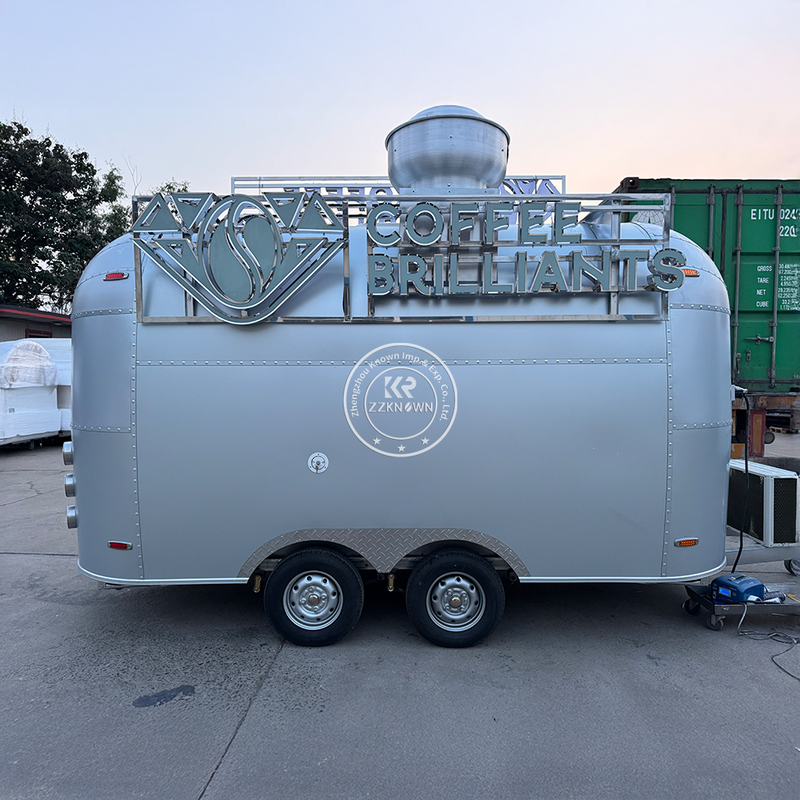
The ZZKNOWN KN-QF400 Airstream food trailer provides a real four-meter starting point. Its lesson for pest control is to coordinate a curved-body opening, serving workflow, interior equipment, and market-specific electrical system before selecting screen or air-curtain hardware.
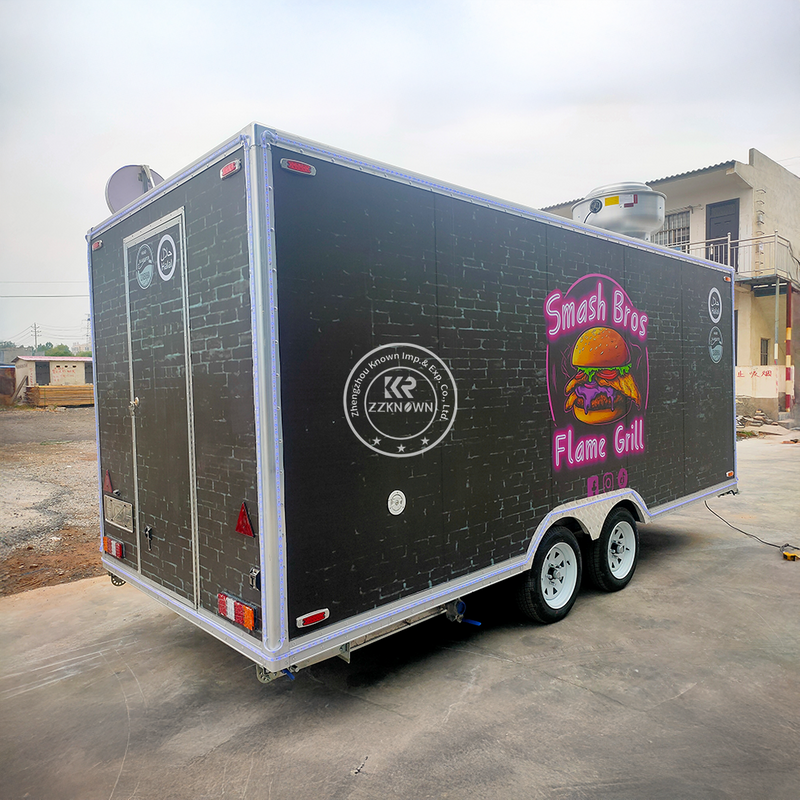
The ZZKNOWN KN-FS500 Australian food trailer uses dual side serving windows for event throughput. The pest-control question is not whether two windows are “good” or “bad”; it is how each opening closes, how the hood affects pressure, and what operating controls the local council expects.
Other useful starting points include the KN-FS400 square food trailer and our broader custom food trailer range. Buyers should compare real openings and workflows, then request changes for their menu and destination rather than copying a photo.
We used a transparent four-part method:
Official-source review: We checked the FDA Food Code 2022, Regulation (EC) No 852/2004 on EUR-Lex, and current FSANZ mobile-food and pest-control guidance.
Manufacturer documentation: We used official product information for the Berner concession-window air-curtain series when naming real equipment models.
Product cross-check: We compared the guidance with published ZZKNOWN models and project pages, including KN-QF400, KN-FS400, KN-FS500, and the 4-meter lemonade trailer.
Engineering interpretation: ZZKNOWN's technical team organized the findings around real drawing-review questions: openings, airflow, cleanability, electrical supply, service clearance, and maintenance.
We did not treat search-volume estimates, supplier claims, or a single jurisdiction's rule as a universal legal requirement. Regulations, adopted editions, and product specifications can change, so the buyer must verify the final package before construction and again before operation.
Frequency | Check | Corrective action |
|---|---|---|
Before opening | Window closes; door self-closes and latches; sweep contacts threshold; screen is intact; no visible light at sealed edges; waste lids close. | Clean, adjust, replace, or keep the affected opening closed until protected. |
During service | Window open time; exterior spills; standing water; air-curtain operation; door being propped; exposed food. | Close between orders, clean spills, cover food, remove waste, restore the approved barrier. |
Weekly | Clean screens, tracks, hatch arms, door gaskets, air-curtain intake/discharge, exterior waste zone, and utility collars. | Document damage and schedule repair before the next high-risk event. |
Monthly / after towing | Door alignment, closer speed, latch compression, sealant, roof/wall penetrations, fan performance, and evidence of pest activity. | Recommission hardware, reseal approved joints, rebalance airflow, or call a licensed professional. |
“Pest-proof trailer” is too vague for a purchase order. Ask the supplier to identify the following:
Service-window clear opening, pane type, frame material, latch, track, and perimeter seal.
Screen material, mesh specification where required, removal method, cleaning access, and storage location.
Air-curtain manufacturer/model or performance basis, mounting height, voltage, circuit, controls, and service clearance.
Personnel-door closer, latch, sweep, threshold, gasket, direction of swing, and emergency-egress coordination.
Location and sealing method for every water, waste, gas, power, refrigeration, communication, hood, and air-conditioning penetration.
Hood exhaust and replacement-air assumptions in normal cooking operation.
Exterior lighting, waste zone, awning, menu board, and any item that could interfere with the protected opening.
Who supplies, installs, commissions, and locally certifies each component.
For the wider equipment plan, use our guide to food trailer kitchen equipment. The menu, hood, refrigeration, staff positions, and service sequence all affect the opening strategy.
Choosing the biggest possible window before planning the menu. More opening is not automatically more throughput.
Using a screen that cannot be removed and cleaned. A grease-loaded screen loses airflow and becomes a maintenance problem.
Buying an air curtain by width alone. Mounting height, discharge, controls, and verified insect-control performance matter.
Ignoring make-up air. Negative pressure turns every small gap into an air inlet.
Leaving future penetrations to installers on site. Unplanned holes are often poorly protected and difficult to clean.
Propping the door open for staff convenience. A self-closing door cannot help when a crate holds it open.
Assuming a factory option equals local approval. The destination authority decides what it accepts.
No universal global rule says every serving window must always have the same screen. The answer depends on the adopted local code, food risk, operating method, and whether another effective protective method—such as a properly designed air curtain—is accepted. Ask the local health authority before approving the window.
The U.S. FDA Food Code §6-202.15 lists 16 mesh to 25.4 mm (16 mesh per inch) as one method for applicable open windows or doors. Do not copy that number into every country. Confirm the local adopted requirement, then specify the mesh, frame, removal, and cleaning method together.
It may be an accepted method in some jurisdictions and applications, including language found in the FDA Food Code, but only when properly designed and installed. Your authority may request product data, installation details, or inspection. Confirm acceptance before purchase.
Potentially yes. Size alone is not the whole decision. Inspectors may consider how the opening closes or is protected, the foods handled, exposure time, environmental risk, nearby waste, and local rules. A large window needs a stronger operational and engineering plan.
The fan may be creating negative pressure. Replacement air then enters through windows and gaps, carrying insects with it. Review hood airflow, planned make-up air, door operation, and window protection together. Do not simply install a larger exhaust fan.
Only if the authority accepts it and it is suitable for the food-service environment. Consider mesh, frame durability, cleanability, grease exposure, removal, corrosion, and how it affects service. Commercial operation is tougher than a home window.
Prevention and sanitation come first. Any pesticide or device must be approved for the intended food-premises use, placed to avoid contaminating food and food-contact surfaces, and managed according to local rules and label directions. When activity cannot be controlled, use a qualified pest-management professional.
Send your destination city, menu, expected hours, climate, event type, staff count, serving method, preferred window dimensions, cooking equipment list, hood requirement, local health-department checklist, and any approved air-curtain or screen specification. This lets the engineering team design around facts rather than guesses.
Send ZZKNOWN your menu, destination, service-window idea, equipment list, and local inspection notes. We can prepare a custom CAD layout showing window type, door details, screen or air-curtain space, ventilation relationship, and utility penetrations for your team and local authority to review.
Request a Free Pest-Proof Layout Review
Editorial note: This article is an engineering and purchasing guide, not legal advice or a permit-ready design. Product models and project images are real published ZZKNOWN references, but configurations and approvals are project-specific. Verify current regulations, adopted code editions, equipment listings, and inspection expectations with the destination authority before production and operation.