Views: 6315 Author: ZZKNOWN Editorial Team Publish Time: 29-10-2026 Origin: ZZKNOWN


Published: October 29, 2026 | Last Updated: October 29, 2026 | Reading Time: 19 minutes
Direct answer: Choose a removable, correctly listed grease filter that matches the hood manufacturer’s dimensions, airflow and pressure-drop limits. For greasy cooking, stainless-steel baffle filters are often a practical starting point because they are durable and drain grease instead of storing it. Install the complete filter bank without gaps, clean it before buildup restricts airflow, and follow the local fire authority’s inspection schedule.
A grease filter is a safety and ventilation component. It is not merely a washable screen, and it does not replace duct, fan or fire-suppression maintenance.
Type I and Type II hoods do different jobs. A condensate hood is not a substitute for a grease-removal system over appliances that produce grease-laden vapors.
Listing and local acceptance matter. U.S. projects commonly reference UL 1046 and the adopted mechanical and fire codes; European projects may reference EN 16282-6. The authority having jurisdiction decides what applies.
Fit is as important as filter material. Air and grease will follow gaps around a filter bank, so nominal size, actual size, frame, spacers and access all belong on the drawing.
Stainless baffle filters are a strong starting point for fryers and griddles, not a universal answer. The hood’s tested or engineered configuration controls.
Clean according to cooking load and evidence. A busy fryer may need much more frequent cleaning than a low-volume oven, even when both trailers use the same size hood.
Never operate with filters removed. Keep a correctly matched spare set if washing and drying cannot be completed between services.
Where and when does this guide apply? It is written for global buyers and compares U.S., European/UK and Australian reference points. Official sources and live ZZKNOWN product pages were reviewed on October 29, 2026. Code editions, local adoption, menu, fuel, appliance listing and insurance requirements vary by destination.
What is this guide not? It is not a permit, fire-engineering report, cleaning certificate or promise that one filter will be accepted everywhere. Confirm the final hood, separator, fan, duct and suppression package with the hood manufacturer and the authority having jurisdiction before production.
Picture a burger trailer ten minutes before the lunch rush. The stainless hood looks clean from the aisle, but smoke starts rolling past its front edge. The fan sounds louder than usual. A worker slides out a dark, heavy filter, washes it quickly and replaces it with a lighter filter that happens to fit the opening. For an hour, the kitchen feels better. Then the smoke returns.
The obvious conclusion is “we need a stronger fan.” The better question is: has the filter bank changed the system the fan was designed to move? Grease filters create resistance. Their free area, construction, dirt loading and installation angle affect pressure drop. Gaps allow dirty air to bypass the filter. A substitute that looks similar can move a different amount of air. The cook sees the symptom at the hood face, but the cause may be a filter, an overloaded cooking line, make-up-air imbalance, a dirty duct or several problems acting together.
Based on CNREALLY KNOWN’s production experience, filter decisions are easiest to get right while the hood and appliance line are still on the CAD drawing. That is a manufacturer’s engineering observation, not a fabricated personal story. When buyers send the menu, appliance model, fuel, duty level and destination early, the team can discuss the filter bank as part of the entire food trailer ventilation system instead of treating it as an accessory added after the hood is built.
A grease filter—or aerosol separator—forces grease-laden exhaust air to change direction. Larger droplets lose momentum, strike the metal surfaces, combine and drain toward a gutter or collection cup. The cleaned air continues into the plenum, duct and exhaust fan. No ordinary filter captures every grease particle, so the downstream system still requires inspection and cleaning.
This distinction matters. The UL Solutions commercial-cooking application guide identifies commercial grease filters under UL 1046 and describes them as removable devices installed in the exhaust stream. The London Fire Brigade’s commercial-kitchen extraction guidance makes the practical point that no filter is 100% effective; grease can still coat internal surfaces when the system is not cleaned properly.
A carbon or activated-charcoal panel can help with selected odor-control designs, but it is not a substitute for the primary grease separator. A fine mesh placed where a listed baffle filter was required is also not an “upgrade” simply because its openings look smaller. It may hold more grease, add resistance or behave differently during a fire.
A Type I hood is used where cooking creates grease or smoke. Fryers, griddles, charbroilers, many ranges and some ovens are typical examples, but the appliance listing and local authority control the answer. A Type II hood mainly handles heat, steam, vapor or odors without grease. A pizza oven, dishwasher or bakery appliance may be evaluated differently depending on its fuel, listing, menu and operation.
Do not choose the filter first and then use it to justify the hood. Start with the cooking process. If the appliance produces grease-laden vapors, the project normally needs a compatible Type I system—including grease removal, duct, fan and fire protection where required. UL’s building-services guide for code officials maps grease removal to IMC Section 507 and NFPA 96 Chapter 6, which is a useful way to see how the components fit together.
Filter or separator | Where it can be a useful starting point | Strengths | Questions and limits |
|---|---|---|---|
Stainless-steel baffle | Fryers, griddles and busy mixed hot lines when accepted in the hood design | Durable; self-draining path; withstands repeated commercial washing; does not rely on packed mesh | Confirm listing, airflow rating, pressure drop, orientation and actual dimensions |
Stainless or aluminum mesh | Only where the hood manufacturer and local authority accept the exact type | Lightweight; inexpensive; large surface area | Can store grease and clog; aluminum may be damaged by aggressive caustic cleaners; do not assume household-style mesh is suitable |
Cartridge, cyclonic or high-efficiency separator | Engineered hoods where finer aerosol capture or a specific tested system is required | Can improve capture within its designed operating range | Often proprietary; replacement parts, washing method and pressure drop must remain within the system specification |
Carbon or odor-media stage | Downstream odor-control systems designed by a ventilation specialist | Can reduce selected odors when correctly sized and maintained | Not the primary grease filter; grease loading can shorten media life and create additional resistance |
For a buyer who expects frequent frying and grilling, a listed stainless baffle filter is usually the most sensible first option to discuss. “First option” is deliberate wording: the final answer must match the hood’s tested or engineered arrangement. If a supplier cannot provide filter dimensions, material, listing information and airflow data, you do not yet have enough information for a safe substitution.
Destination example | Reference to discuss | What it means for the buyer |
|---|---|---|
United States | NFPA 96, adopted mechanical/fire code and UL 1046 listing | Verify the adopted code edition, local amendments, listed hood/filter package and fire-marshal review. NFPA’s live page now displays the 2027 edition; your jurisdiction may use an earlier edition. |
Europe and United Kingdom | BS EN 16282-6:2020 plus national/local fire and workplace requirements | Discuss aerosol-separator design, drainage, installation, durable marking, removal and operating instructions with the project designer. |
Australia and New Zealand | AS 1668 framework, gas/electrical rules, local council conditions and food-premises cleaning duties | Check open-flame clearances, separator acceptance and service access. Energy Safe Victoria’s GIS 62 is a useful state-level example, not a substitute for project approval. |
The U.S. 2021 Rhode Island Mechanical Code’s publicly accessible Chapter 5 illustrates common IMC provisions: Type I grease filters are listed and labeled to UL 1046, accessible for cleaning, removable without tools, arranged to pass the required airflow within their rating, installed at least 45 degrees from horizontal and provided with a drip tray. Its example minimum filter-to-cooking-surface distances are 0.5 feet for appliances without exposed flame, 2 feet for exposed flame or burners and 3.5 feet for charcoal or charbroil equipment. Those numbers belong to that adopted code example; do not copy them into another project without checking its code and appliance listing.
Do not start with a website label such as “20 × 20 filter” and assume the physical frame is exactly that size. Nominal and actual dimensions can differ. Measure the hood’s filter opening, frame depth and retaining method. Count every filter and spacer. Record the airflow rating and pressure drop at the design flow. The filter bank must cover the intended opening without loose gaps and still be removable without tools.
Parameter to put on the drawing | Why it matters | What to verify |
|---|---|---|
Actual filter width × height × depth | Prevents buying a nominal size that leaves a gap or will not seat | Manufacturer data sheet and frame measurement |
Quantity and blank-off/spacer pieces | Stops air from bypassing the separators | Full bank shown in elevation |
Rated airflow and pressure drop | Links the filter to fan selection and capture performance | Clean rating plus expected dirty-filter behavior |
Drain direction and installation angle | Allows separated grease to reach the gutter and receptacle | Orientation arrows, baffle direction and hood instructions |
Material and wash chemistry | Determines durability and compatible detergent | Stainless grade or aluminum construction and manufacturer cleaning instructions |
Appliance clearance | Reduces flame and heat exposure and supports compliant capture | Adopted code, appliance listing and hood listing |
Engineer’s note: The filter bank is part of an airflow system, not a row of interchangeable metal panels. Reducing free area or installing a higher-resistance substitute can move the fan away from its design point. Leaving gaps may lower resistance but sends grease into the plenum and duct. Review hood face capture, filter pressure drop, fan curve and replacement air together before approving a substitution.
Install every filter in the direction marked by its manufacturer. Seat the lower edge in the grease channel, then secure the upper edge in the retaining track. The baffle paths should drain toward the gutter; the grease cup or receptacle must be accessible and in place. Use the hood maker’s matching spacers or blank-off plates—never a loose strip of sheet metal that can fall onto hot equipment.
Stand at both ends of the hood and look for daylight around the bank. Check that filters cannot rattle free during travel. A mobile kitchen adds vibration, so transport security matters even when the same filter would remain stable in a fixed restaurant. Before cooking, remove any shipping film, fasteners or packaging that could restrict airflow or melt.
There is no honest global answer such as “every seven days.” Cleaning frequency follows the amount and type of cooking, hours of operation, fuel, filter design and local fire-risk requirements. A fryer-and-griddle trailer working two festival shifts each day may need filter washing daily or several times per week. A low-volume unit using a listed oven may need less frequent work. The trigger is grease accumulation and airflow—not the fact that the calendar says Monday.
Practical control point | Heavy fryer/griddle starting point | Evidence to record |
|---|---|---|
Filter face and grease cup | Visual check before each service; empty safely as needed | Photo or opening checklist; drips, dark loading or odor |
Removable filter wash | Begin with daily/very frequent inspection and set washing by observed load | Date, filter set, method, condition and employee initials |
Gutter, plenum and accessible hood surfaces | Inspect during filter removal; clean only by an approved safe method | Buildup location, leaks and damaged fasteners |
Duct, fan and complete exhaust system | Professional inspection/cleaning at the locally required risk-based interval | Service report, before/after evidence and next due date |
Local guidance can help you build a starting schedule, but it is not globally binding. For example, the London Borough of Hillingdon recommends at least weekly cleaning for self-draining filters and more frequent cleaning for mesh filters in its commercial-kitchen guidance. The London Fire Brigade’s current restaurant fire-safety leaflet tells operators to clean filters and ducting regularly to prevent grease buildup. Use local examples to ask better questions, then follow the schedule required by your own fire authority, insurer and system manufacturer.
Shut down safely. Turn off cooking equipment, allow hot surfaces to cool and follow the exhaust and fire-suppression service instructions. Protect electrical components from water.
Use suitable PPE. Filters can be hot, slippery and sharp. Wear gloves, eye protection and footwear appropriate for the cleaning chemical and workspace.
Remove filters in order. Support the weight, keep grease from dripping onto appliances and mark positions if the bank uses different sizes.
Remove loose grease first. Scrape or wipe it into an approved waste container. Do not wash concentrated grease into a storm drain or onto the ground.
Wash with the approved chemistry. Follow the filter maker’s detergent, water-temperature, dishwasher or soak-tank instructions. Strong caustic products can attack aluminum and some finishes.
Rinse and air-dry completely. Cleaning removes soil; it does not automatically mean a filter needs food-contact sanitizing. The Food Standards Australia New Zealand cleaning guide is useful for understanding the difference between cleaning and sanitizing. Grease filters are not food-contact utensils, so follow the ventilation manufacturer’s method.
Inspect before reinstalling. Replace bent frames, broken handles, separated baffles, corroded mesh or filters that no longer sit flat. Check the gutter and grease cup.
Reinstall and record. Confirm orientation, complete the full bank, run the fan and log the date and condition. Never start cooking with a missing filter.
Do not pressure-wash the hood interior while electrical equipment, detectors, suppression nozzles or cooking appliances are exposed. Do not move, cap or spray fire-suppression components unless the qualified system provider has authorized the procedure. Filter washing is routine operator maintenance; duct cleaning and suppression-system service are separate professional tasks.
The models below are real published platforms. They help turn a vague filter discussion into a menu-and-equipment review. They are not claims that the listed configuration is automatically approved in every destination.
Real model | Published hot-line configuration | Filter question to resolve |
|---|---|---|
4 × 2 × 2.3 m body; gas fryer and griddle; 2 m range hood and exhaust | Which listed baffle filter bank, airflow and cleaning rotation match simultaneous frying and grilling? | |
4 m body; griddle, fryer and stove; 2 m hood; 110V/60Hz package | Does the exact hood/filter package carry the listing and documentation requested by the destination fire marshal? | |
4 m body; pizza oven; optional 1.5 m hood published with a honeycomb grease filter | Will the final oven, fuel and local approval accept that separator, or should the hood/filter design change? | |
Compact 4 m mobile kitchen with frying and stove options | How much grease and steam will the actual menu produce, and how will make-up air protect capture in the narrow aisle? |
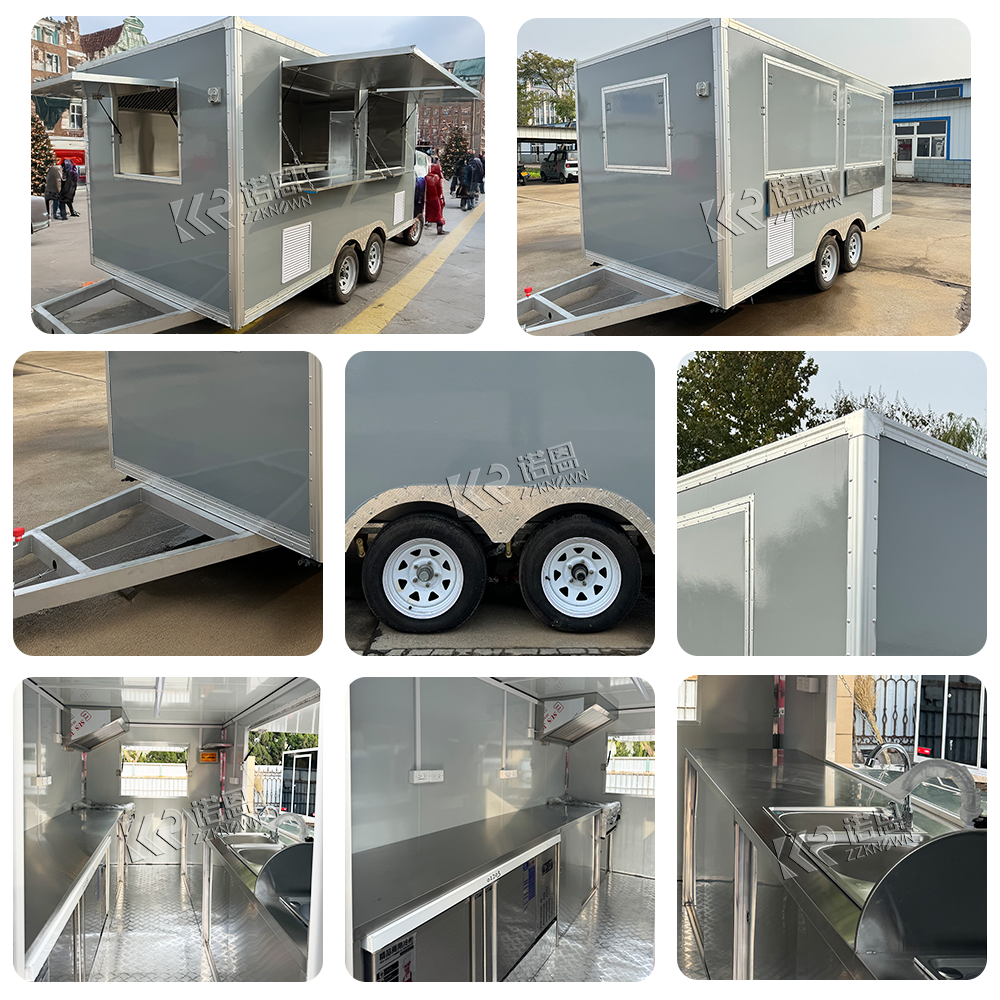
Real ZZKNOWN project image: review whether staff can remove the complete filter bank without standing on hot equipment or blocking the aisle. The photo is a layout reference, not proof of approval in another jurisdiction.
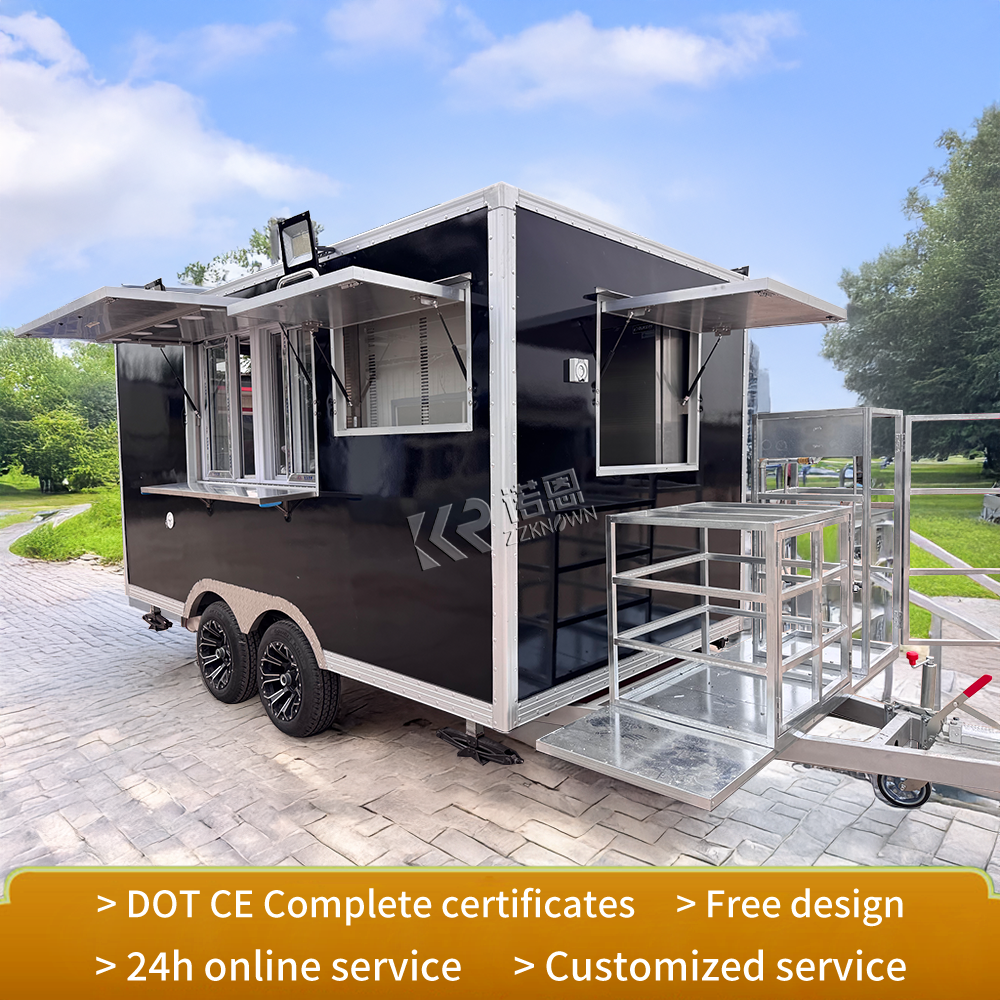
Real ZZKNOWN burger-trailer project image: frying and griddling create a higher grease load than beverage-only service, so the hood/filter maintenance plan should be written before opening.
Keep a filter register with the hood ID, filter type, actual size, part number, quantity, listing or certification information, approved detergent, wash method and spare quantity. Add a simple service log showing date, cooking hours or service type, grease condition, person responsible, damage found and corrective action. Store professional duct-cleaning and fire-suppression reports with the trailer records.
Photos can help reveal a shortening cleaning interval, but they do not replace inspection. A filter can look bright on the aisle side while the back, gutter or plenum is heavily loaded. If smoke begins escaping, fan noise changes, odor increases or grease appears downstream, stop treating the problem as cosmetic and have the complete system assessed.
For broader preventive work, connect the exhaust log to the ZZKNOWN electrical-load guide so the fan remains a protected design load, and review grease-adjacent surfaces using the food trailer wall and ceiling materials guide. Fire-risk questions can be compared with our vent hood and fire-suppression overview; local approval still controls.
We used a four-step method. First, we reviewed official technical sources from NFPA, ICC, UL Solutions, BSI, London Fire Brigade, Food Standards Australia New Zealand and Energy Safe Victoria. Second, we separated globally useful engineering principles from local code examples. Third, we checked live ZZKNOWN model pages for hood length, cooking equipment, voltage and published filter descriptions. Fourth, the CNREALLY KNOWN engineering team reviewed the resulting selection and maintenance checklist against normal food-trailer layout decisions: hood access, appliance clearance, filter-bank fit, grease drainage, fan loading and cleaning space.
We did not invent a global cleaning interval, claim that a factory model has local approval, convert a proposed code change into a current requirement or present generated artwork as a real customer photograph. The two project photos above come from live ZZKNOWN product content; the title image is an original technical illustration created for this guide.
Not in every engineered system, but stainless baffle filters are often a durable, self-draining choice for grease-producing mobile kitchens. Use the type specified and accepted for the hood. Do not replace one design with another based only on size or price.
No, not as an informal substitute. Commercial cooking filters must match the hood, cooking duty and applicable listing or standard. A household filter may clog, store grease, deform or fail the local inspection requirement.
Hood length alone is not enough. The answer depends on the filter opening, actual filter dimensions, airflow per filter, spacers and the hood maker’s design. Ask for a filter-bank elevation showing every filter and blank-off piece.
Inspect them before each service and establish the washing interval from observed loading, cooking hours, local rules and manufacturer instructions. A busy fryer/griddle operation may need daily or very frequent washing. Keep a spare matched set if turnaround time is a problem.
The fan may be tested under the manufacturer’s instructions, but do not cook with filters missing. Use a complete approved spare set and reinstall every filter in the correct orientation before hot equipment operates.
No. Some grease passes the separator and accumulates in the plenum, duct and fan. These parts need professional inspection and risk-based cleaning at the interval required by the authority, insurer and system provider.
They remove part of the grease aerosol, which can reduce some odor indirectly, but they are not a complete odor-control system. Odor control may require menu changes, capture improvement, discharge planning or an engineered downstream treatment stage.
Send the destination city and country, menu, appliance models and fuel, cooking quantity, trailer size, operating hours, required standard, service access limits and any comments from the local fire or health authority. Photos of similar equipment are helpful, but model data sheets are better.
Send ZZKNOWN your destination, menu, appliance list, fuel type, trailer size and expected cooking volume. The CNREALLY KNOWN engineering team can review hood length, filter bank, access, grease drainage, exhaust, replacement air and fire-suppression coordination before production.
Request a Grease-Filter & Hood Layout + Factory Quote
Author: ZZKNOWN Editorial Team
Technical Review: CNREALLY KNOWN Ventilation & Food Trailer Engineering Team
Editorial standard: Product specifications were checked against the linked live pages. Regulatory claims link to official sources and local examples are labeled. No invented personal experience or fabricated buyer result is presented.