Views: 2554 Author: ZZKNOWN Publish Time: 19-08-2026 Origin: ZZKNOWN


ZZKNOWN ENGINEERING GUIDE
Published: August 19, 2026 | Last Updated: August 19, 2026
Author: ZZKNOWN Editorial Team | Technical Review: ZZKNOWN Mechanical & Safety Engineering Team
Direct answer
A food trailer ventilation system captures heat, smoke, steam, grease, and odors at the cooking line, filters grease, moves contaminated air through a sealed duct, and discharges it safely outside. A complete design may also need replacement air, fire suppression, electrical or gas interlocks, and accessible cleaning points. Hood size and fan airflow must match the actual appliances, trailer layout, and destination rules.
Start with the menu and exact appliance models. A fryer, griddle, charbroiler, pizza oven, and coffee machine create very different ventilation loads.
A hood and a fan are not the whole system. Filters, ductwork, discharge location, replacement air, controls, fire protection, and cleaning access matter too.
More airflow is not automatically better. Too little exhaust loses smoke; too much can waste energy, increase noise, and depressurize a small trailer.
Make-up air must arrive gently. Air blown across the cooking plume can push smoke out from under an otherwise adequate hood.
Grease cooking usually changes the safety category. A Type I hood and an approved fire-extinguishing system may be required by the authority having jurisdiction.
Local approval controls the final design. A factory drawing is a planning tool; it does not replace review by the fire marshal, health department, building official, gas inspector, or other local authority.
This guide is written for buyers in the United States, Canada, Europe, the United Kingdom, Australia, New Zealand, the Middle East, and other export markets. Public standards pages, manufacturer specifications, and laboratory examples were checked on August 19, 2026. The airflow figures are early-planning references, not permit-ready calculations.
Commercial-kitchen ventilation rules differ by country, state, province, city, event venue, fuel type, and appliance listing. Even within one country, the adopted code edition and the authority having jurisdiction can change the answer. Ask your local reviewer which documents apply before ZZKNOWN freezes the equipment line, hood, roof penetrations, gas arrangement, and electrical panel.
Imagine that you are ordering a 16-foot trailer for smash burgers and fries. The customer-facing decisions are exciting: the serving window, exterior color, illuminated menu, griddle width, and fryer capacity. Ventilation feels like a stainless box that can be added later.
Then the hidden questions arrive. How far must the hood project beyond the appliances? Where can the duct rise without crossing structural members? Will the fan discharge grease-laden air near the serving window? Where will replacement air enter? Can staff remove the baffle filters without reaching over a hot fryer? Does the fire-suppression system need to shut off gas and electricity automatically?
Based on CNREALLY KNOWN's production experience, the most reliable projects answer those questions while the layout is still flexible. ZZKNOWN first asks for the menu, fuel type, appliance model numbers, dimensions, heat duty, destination, and expected inspection path. Only then should the hood length, airflow target, fan, duct route, fire protection, electrical load, and roof structure be coordinated.
Engineer's note
“The hood should be designed around the cooking plume, not simply around the countertop. Show us the exact appliance line and operating menu. A quiet griddle test in an empty factory is not the same as two fryers and a charbroiler working during a lunch rush.” — ZZKNOWN Mechanical & Safety Engineering Team
A practical system is easier to understand if you follow the air from the cooking surface to the outdoors:
The capture hood creates a reservoir above and around the appliance plume.
Grease filters or aerosol separators remove part of the grease before the air enters the duct.
The exhaust duct carries contaminated air through the trailer envelope.
The exhaust fan and discharge create the pressure needed to move air and release it away from people, openings, and combustible hazards.
Replacement or make-up air brings outdoor air back into the trailer so the exhaust system can work without creating excessive negative pressure.
Controls connect these pieces. Depending on the jurisdiction and equipment, the fan may need to operate whenever cooking equipment is on, and a fire-suppression release may need to shut down fuel or electrical heat sources. The exact sequence must be designed and commissioned for the approved system.
This is usually the first classification question. The simple difference is whether the cooking process produces grease-laden vapors or mainly heat, steam, and condensation. Local terminology and exemptions vary, so use the table as a conversation starter rather than an approval decision.
Planning question | Type I hood | Type II hood |
|---|---|---|
What does it handle? | Grease-laden vapors, smoke, heat, and combustion products where applicable | Primarily heat, steam, vapor, and condensation without grease-laden cooking |
Common examples | Fryers, griddles, charbroilers, ranges, and many solid-fuel or high-heat processes | Some dishwashing, steaming, baking, or warming applications when accepted locally |
Grease filtration? | Yes; listed baffle filters or other approved grease-removal devices are typical | Not normally intended for grease capture |
Fire suppression? | Frequently required for grease-producing commercial cooking; confirm with the authority having jurisdiction | Depends on appliance and local rules; it is not automatically exempt |
A recirculating or ventless hood is not a universal shortcut. It may be suitable only for specifically listed appliances and approved applications. Many local authorities still require outdoor exhaust, fire protection, odor control, or additional mechanical ventilation. Obtain written acceptance before building around a ventless concept.
There is no honest one-number answer. Airflow depends on appliance duty, heat and grease production, hood style, hood length and depth, overhang, mounting height, end panels, cross-drafts, duct resistance, fan performance, and the calculation method required locally.
For a useful sense of scale, the table below compares identifiable manufacturer guidance and laboratory results. These values are not interchangeable code requirements.
Published example | Airflow data | How a buyer should use it |
|---|---|---|
Published minimum examples per linear foot: 150 CFM/ft at 450°F, 200 CFM/ft at 600°F, and 250 CFM/ft at 700°F for the shown single-wall duty categories | Useful early reference for one real listed hood family; final airflow depends on the selected configuration and approved cooking duty. | |
Gas charbroiler: 2,100 CFM (263 CFM/ft). Electric griddle: 1,350 CFM (169 CFM/ft). | Shows how appliance duty changes capture demand. The manufacturer states these ASTM F1704 lab values are not suitable for every application. | |
When code does not specify: 50 CFM/ft² for light duty, 70 CFM/ft² for medium duty, and 100 CFM/ft² for heavy duty | An area-based manufacturer guideline. Greenheck also notes that some local codes require 100 CFM/ft² for wall hoods. | |
Current catalog examples include CUBE-099 at 759–1,260 CFM, CUBE-120 at 553–2,043 CFM, and CUBE-140 at 635–3,134 CFM | Confirms that a model name alone is not a selection. Required CFM and static pressure must intersect the selected fan curve. |
For illustration, a six-foot ND-2-style hood at the cited linear-foot rates would start around 900 CFM for the 450°F category, 1,200 CFM for the 600°F category, or 1,500 CFM for the 700°F category. Those are transparent multiplication examples—not ZZKNOWN promises, permit values, or substitutes for the manufacturer's approved selection.
We used a repeatable method that buyers can audit:
Selected public documents from official regulators, standards bodies, and established commercial-ventilation manufacturers.
Recorded the exact hood or fan family, cooking-duty category, units, and stated limitations.
Kept linear-foot data, hood-area data, laboratory capture tests, and fan performance ranges in separate rows so they are not mistaken for the same method.
Used simple multiplication only for the clearly labeled six-foot planning example.
Checked links and public specifications on August 19, 2026; manufacturers and authorities may revise documents after that date.
Excluded anonymous marketplace listings and unsourced “typical CFM” charts.
Because capture is not just a fan-volume problem. The hood needs enough overhang and reservoir volume to intercept the rising plume. A high fan speed cannot fully correct a hood that is too short, mounted too high, or exposed to a strong cross-draft.
Watch what happens around the serving window and entry door. Wind entering an open window can bend the plume away from the filters. A ceiling diffuser pointed toward the cookline can do the same. Even staff movement in a tight aisle can disturb capture during peak service.
This is why capture-and-containment testing matters. The cooking equipment should operate under representative load while the team observes whether heat, vapor, and smoke escape at the hood edges. Airflow measurements, smoke visualization methods accepted by the commissioning professional, and fan speed adjustments can then confirm performance.
If the exhaust fan removes 1,500 CFM, approximately that quantity of air must come from somewhere. Without a planned path, the trailer pulls air through doors, serving windows, plumbing gaps, and other leaks. The result may be hard-to-open doors, drafts across food, poor hood capture, uncomfortable staff, or combustion problems.
Make-up air is controlled replacement air. It may enter through a dedicated supply fan, a hood plenum, ceiling diffusers, or another engineered route. The goal is not to blast air at the fryers. Supply velocity and direction should support the hood plume instead of breaking it apart.
In hot, cold, or humid climates, replacement air also affects comfort and energy use. Unconditioned outdoor air can overwhelm a small air conditioner or create condensation. A balanced design considers ventilation and climate control together rather than sizing each system alone.
Filters: Type I hoods commonly use removable stainless baffle filters installed at the approved angle. They should drain toward a grease collection point and be reachable for routine cleaning. Do not replace an approved baffle filter with improvised mesh.
Ducts: Grease ducts must be constructed, joined, routed, and protected according to the applicable code and listed system instructions. The route should be as direct as practical while preserving cleaning access. Unnecessary elbows add resistance and grease-collection points.
Fans: Select the fan at both required airflow and system static pressure. The pressure includes losses through filters, duct length, elbows, transitions, and discharge components. Greenheck's CUBE is one recognizable upblast family for grease exhaust; its current catalog spans many sizes and performance points. That breadth is exactly why “use a CUBE fan” is incomplete without a model and duty point.
Discharge: Exhaust should be directed away from roof surfaces, air intakes, openings, customers, and combustible materials as required locally. In a mobile unit, the relationship between rooftop fan, serving window, folding canopy, signage, and transport height deserves special attention.
Grease exhaust and fire protection are closely connected. The NFPA Food Truck Safety Fact Sheet explains that appliances producing grease-laden vapors, together with potential grease deposits in the hood, grease-removal device, and duct, must be protected by fire-extinguishing equipment. It also addresses portable extinguishers and fuel safety.
A complete suppression design normally considers nozzles over protected appliances, the hood and duct, manual activation, automatic detection, fuel or power shutdown, and system inspection. Appliance positions cannot be casually changed after the nozzles are installed. If you want a modular cookline, tell the fire-system designer before certification.
The current NFPA 96 (2024 edition) covers ventilation control and fire protection for commercial cooking, including mobile and temporary cooking operations. Your adopted local edition may differ, and the final system should be installed and serviced by qualified, locally accepted professionals.
Market or use | Official reference | Why it matters |
|---|---|---|
United States / model fire standard | Hoods, grease removal, ducts, air movement, fire-extinguishing equipment, cleaning, inspection, and mobile cooking | |
United States / food sanitation model | FDA Food Code 2022, Section 4-204.11 | Exhaust hoods must prevent grease or condensation from dripping onto food, equipment, utensils, linens, or single-service items |
International engineering reference | Design criteria for commercial cooking ventilation, including hoods, exhaust, and replacement-air systems | |
Australia | Mechanical ventilation in buildings, with revised provisions for kitchen exhaust; confirm applicability to the specific mobile installation | |
UK practice | Widely recognized UK guidance for commercial-kitchen ventilation design, installation, grease separation, and maintenance | |
Europe / UK standards series | General calculations, hoods, air inlets/outlets, ducts, aerosol separators, and fixed fire-suppression components |
These references are not a universal permit package. The legal requirement is the version adopted in your destination plus any vehicle, gas, electrical, health, fire, environmental, and event rules that also apply.
Ventilation must fit the business concept and the physical trailer. A compact stock unit and a 5-meter high-output cookline should not receive the same hood simply because both are called food trailers.
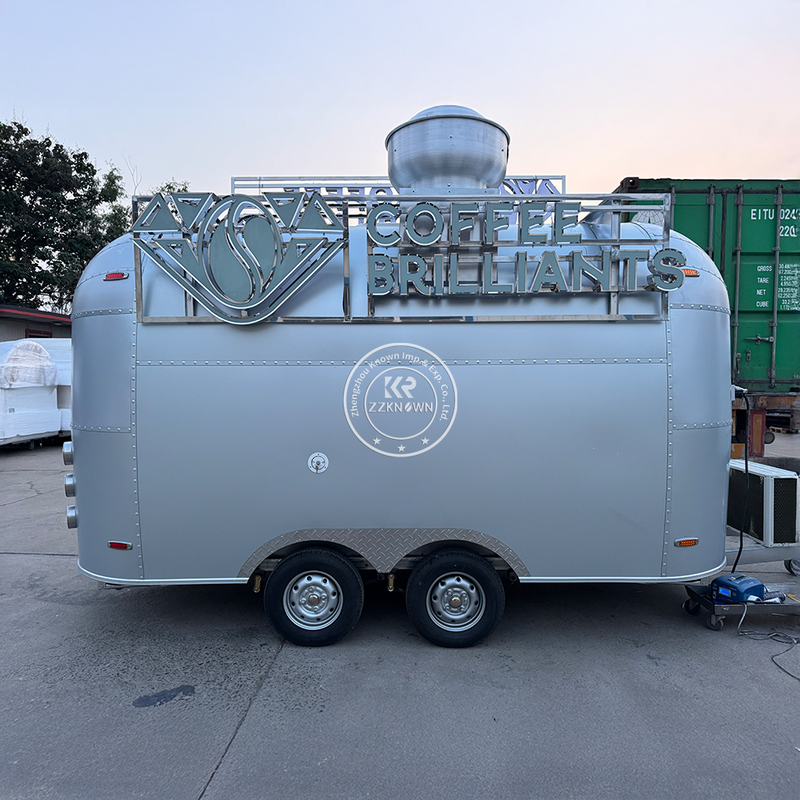
KN-QF400 U.S.-ready aluminum food trailer
A 4-meter platform with a canopy and sink package. The final exhaust design depends on whether the menu uses coffee equipment, a griddle, fryers, or grease-producing cooking. View the KN-QF400 project.
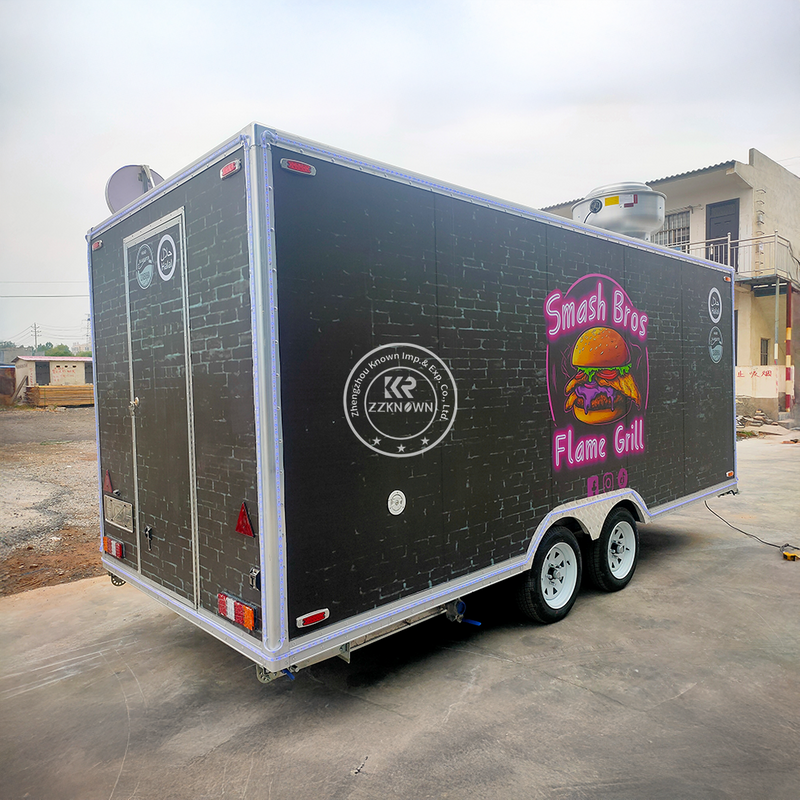
KN-FS500 Australian mobile kitchen
A 5-meter multi-menu platform gives more equipment capacity, but the longer hot line can increase hood, duct, fan, electrical, and make-up-air requirements. View the KN-FS500 project.
Other real starting points include the KN-FS400 commercial pizza food trailer and the compact KN-FR220B U.S. 110V stock trailer. Model pages show a platform, not automatic local approval. ZZKNOWN adjusts the layout, equipment, utilities, and ventilation discussion for the buyer's menu and market.
Planning factor | Light-duty concept | Medium-duty concept | Heavy-duty concept |
|---|---|---|---|
Illustrative menu | Coffee, cold desserts, light warming | Burgers, griddle items, limited frying | Charbroiling, multiple fryers, wok or solid-fuel cooking where permitted |
Likely hood discussion | Type II or no cooking hood only if the local authority accepts the appliance set | Type I hood, grease filters, fire suppression, and balanced replacement air commonly considered | Higher-duty Type I system, greater heat and grease control, stronger fire and fuel coordination |
Airflow and noise | Lower potential airflow, subject to appliance and code | Moderate airflow; supply-air placement becomes important | Higher airflow and static pressure can increase fan size, motor load, and sound |
Project impact | Simpler roof and power planning may be possible | Coordinate hood, duct, fan, suppression, electrical panel, and gas line early | May require a larger trailer, more make-up air, additional power, heat protection, and specialized approval |
We do not publish a universal installed price for these columns because cost depends on hood length, listing, fan duty, duct route, suppression system, supply air, controls, freight, local labor, permits, and certification. A low headline price without those boundaries is not a useful comparison.
Begin with correct sizing. A poorly selected small fan running near its limit can be noisy, while an oversized fan may create unnecessary air velocity and motor noise. Use the fan curve to select an efficient operating point, minimize restrictive duct transitions, keep filters clean, isolate vibration, and avoid placing the discharge directly above quiet customer areas when the design allows.
Do not slow the fan until smoke disappears from view in an empty trailer and call the job complete. Capture must be tested with the real cookline operating. If a variable-speed controller is allowed, establish an approved minimum speed and control sequence.
Cleaning frequency follows use intensity, fuel, grease production, manufacturer instructions, and local rules. A busy burger-and-fry trailer can load filters much faster than a coffee unit. The following is an owner planning checklist, not a replacement for legally required professional inspection.
When | What should be checked? | What should trigger service? |
|---|---|---|
Before each service | Fan operation, unusual sound, visible damage, filter position, grease cup, and clear discharge area | Fan fails to start, vibration, loose filter, electrical odor, or blocked discharge |
After service / routine cleaning | Wash removable filters using the approved method; clean accessible hood surfaces and grease collection | Heavy deposits remain, filter damage, or grease reaches areas not intended for routine access |
Scheduled professional inspection | Hood, full duct, fan, roof or wall discharge, fire suppression, fuel shutdown, controls, and documentation | Any grease accumulation, corrosion, failed interlock, inaccessible section, or missed inspection interval |
Country, state or province, city, and intended event or operating locations
Complete menu and expected daily volume
Exact cooking appliance brands, model numbers, dimensions, fuel, and specification sheets
Preferred trailer model and working length
Local hood, fire-suppression, gas, electrical, health, and vehicle requirements already received
Available shore power, generator, battery, and gas supply
Desired air conditioning, heating, serving windows, doors, and staff count
Any limits on transport height, site noise, rooftop equipment, exhaust odor, or open flames
For electrical coordination, read the food trailer electrical system guide and the equipment power-consumption guide. If you are still choosing appliances, the mobile food trailer equipment guide will help you build the first list.
Not every trailer needs the same hood. A cold-food or sealed-appliance concept may have different requirements from a fryer trailer. The menu, appliance listing, grease production, heat, steam, fuel, and local authority determine whether no cooking hood, a Type II hood, a Type I hood, or a listed recirculating solution is acceptable.
Required overhang varies with hood type, appliance duty, listing, mounting arrangement, and adopted code. Do not use one internet dimension for every market. Send the exact appliance line to the hood supplier and local reviewer.
Possibly, if the hood, filters, duct, airflow, and suppression system are designed for the combined duty and each protected appliance remains in its approved position. A charbroiler can drive a much higher capture requirement than a griddle.
No. Adequate capture is essential, but excessive exhaust can increase noise, energy use, drafts, and negative pressure. Correct hood geometry and gentle make-up air are as important as fan volume.
Usually not by itself. Many small air conditioners recirculate indoor air rather than replacing the large volume exhausted by a cooking hood. The mechanical designer must verify the outdoor-air path and pressure balance.
Options depend on the destination, accepted listing, local installer requirements, appliance layout, shipping restrictions, and inspection process. ZZKNOWN can coordinate space and routing, but the buyer must confirm what the local authority and licensed fire-system provider will accept.
Only after checking hood duty, airflow, electrical or gas capacity, clearances, suppression nozzles, weight distribution, and local approval. Replacing a countertop appliance can change several engineered systems at once.
Common causes include dirty filters, a slipping or failing fan, insufficient airflow, excessive duct resistance, poor hood overhang, open-window cross-drafts, badly directed make-up air, an appliance pushed outside the capture zone, or cooking beyond the design duty. Stop unsafe operation and have the system inspected.
Send ZZKNOWN your menu, destination, appliance model list, fuel type, and preferred trailer size. Our team will prepare a practical layout discussion covering the cookline, hood footprint, duct route, fan and make-up-air space, utilities, and inspection questions.
Request a Ventilation & Kitchen Layout Review
Editorial disclosure: This article provides educational planning information, not engineering certification, legal advice, or approval for operation. Manufacturer models and public standards are named so readers can verify the source. Product availability, specifications, codes, and official interpretations can change. The authority having jurisdiction and qualified local professionals control the final design.