Views: 2 Author: ZZKNOWN Editorial Team Publish Time: 17-11-2026 Origin: ZZKNOWN


Published: November 17, 2026 | Last Updated: November 17, 2026 | Reading Time: 16 minutes
Direct answer: A food trailer LPG cylinder cabinet should keep cylinders upright and restrained, separate leaked gas from the kitchen, vent to the outside, and let a trained operator reach the shutoff without entering the trailer. Mounting, vent area, fire resistance, cylinder quantity and clearance rules depend on the destination. Ask for a dimensioned cabinet and gas-line drawing before approving production—not just a photo of a metal box.
Put the location on the drawing. An outside-mounted box and a body-recessed locker are different designs; neither is automatically approved.
Secure the actual cylinders. Specify their diameter, height, valve position, restraint, door clearance and travel condition before fabricating the cabinet.
Vent the cylinder space to outdoor air. LPG vapor is denser than air; a decorative grille is not proof that a leak can disperse safely.
Keep the gas compartment separate. Do not use it as general storage for a battery, generator, cleaning chemicals or spare food packaging.
Make shutoff and service practical. The operator and local gas technician need access to the cylinder valve, regulator, pipework and emergency isolation point.
Obtain destination approval. A product photo or “gas box included” line does not establish U.S., UK, Australian or other local compliance.
Region and data update: This global buyer's guide compares official U.S. NFPA, UK local-authority and Australian WorkSafe material available on November 17, 2026. The dimensions and numbers below are labeled by jurisdiction; they are not universal specifications. Product details were checked against the linked ZZKNOWN pages on the same date.
Safety boundary: This is a procurement and layout guide, not a gas-installation manual, engineering sign-off or guarantee of inspection approval. A qualified gas professional and the destination authority must approve the actual system.
Imagine your trailer arrives in time for a busy weekend market. The cooking line looks great. The serving window is where you wanted it. Then the local inspector asks to see the propane cylinder compartment and the emergency shutoff. You open a small hatch and realize the cylinder can only be pulled out after moving a generator. The vent slots face the underside of the trailer. Your quote said “gas box,” but nobody agreed on what that box needed to do.
That is the sort of surprise a buyer can prevent while the layout is still a drawing. Based on CNREALLY KNOWN's production experience, gas equipment and the cylinder cabinet are best planned together with the trailer frame, kitchen line, electrical system and service access. The point is not to make every trailer look alike. The point is to decide, before welding, where gas could go in a leak, how the cylinder will stay put on the road, and how an operator will shut it off quickly.
For most buyers, start the conversation with an exterior location: a purpose-built box on the drawbar or an externally accessed compartment integrated into the body. The correct choice depends on trailer dimensions, axle loading, towbar design, cylinder size and the rules where the trailer will trade. A drawbar box is easy to spot and service, but it adds mass in front of the axle and may interfere with hitch access, turning clearance or a front-mounted generator. A recessed compartment can preserve the exterior silhouette, but its wall, floor, seals and vents must actually isolate it from the kitchen.
Do not simply place a cylinder beside the fryer because there is room under the counter. The UK City of Bradford's mobile food business guidance says gas bottles must not be stored inside the vehicle unless in a specially constructed compartment. The door should be outside, and the cylinder space separated from the interior by a fire-resistant wall. That is UK local guidance, not a promise that the same wall specification applies in every country.
Now look beyond the box itself. What is next to it? A serving window, entry door, generator exhaust, battery enclosure, electrical inlet, hot cooking exhaust, drain or pedestrian queue may change the safe placement. Torbay Council's mobile catering gas-safety checklist asks operators to keep cylinders away from openings, ignition sources, passing vehicles and drains. Its examples help you question a proposed layout, but the required clearance for your project must come from your local gas and fire authority.
Choose the cylinders first, then design the cabinet around them. Ask the gas supplier in your destination market for the cylinder dimensions, connection type, filled weight, regulator arrangement and any reserve-cylinder plan. Do not assume the commonly pictured bottle is the bottle you can buy locally. A cabinet that fits an empty sample cylinder but blocks access to a full cylinder's valve is not a finished design.
The cylinder should sit in the orientation approved for its type—typically upright for portable LPG cylinders—and be positively restrained against tipping, bouncing and lateral movement. A hinged door is not the restraint. Neither is a loose rope. WorkSafe Queensland's cylinder-handling guidance calls for upright storage and securing cylinders so they cannot fall or be knocked over; Torbay's mobile-catering checklist also calls for cylinders to be secured upright during transit and turned off while the vehicle is moving.
On the drawing, ask for a base cradle or appropriately designed support, a strap or bracket that does not abrade the cylinder, and enough room to inspect and replace the bottle without forcing the valve against the roof. Confirm whether the restraint works for both the full and reserve cylinder. The fabricator should also show how the cabinet fastens to a load-bearing part of the trailer rather than to thin decorative cladding. This is a design-review question; it is not a torque specification or a substitute for a structural calculation.
LPG vapor can collect near the floor when released. WorkSafe Queensland explicitly notes that LPG is denser than air and can accumulate in low areas. This is why a cabinet with only a small vent high in the door can be a poor answer to a leak near the cylinder base. The goal is a continuous path to outdoor air that is not blocked by the cylinder, packaging, mud, a skid plate or a trailer panel.
Ventilation requirements are local and design-specific. Torbay Council's UK checklist describes high- and low-level ventilation directly to the outside, with each vent having a free area of at least one-hundredth of the compartment floor area. Bradford highlights floor ventilation holes for its local guidance. Do not turn either example into a universal “1% rule.” The vent location, free area and protection from weather or pests must be reviewed under the destination's applicable standard and by a competent gas professional.
Ask your supplier to label the clear free area, not merely the grille's outside dimensions. A grille, screen and louver can all reduce the open area. Ask where rainwater drains, whether insects can enter, and how the owner will keep the vents clean after months of roadside dust. If the cabinet is recessed into the body, ask for a section drawing showing that the vent opens outdoors rather than into a hidden chassis void or kitchen cavity.
Engineering review note—not a construction detail
Trace a hypothetical leak from the cylinder valve to the lowest part of the cabinet. Ask: Where would that gas go next? If the answer is “into the food prep area,” “under the trailer with no clear exit,” or “toward an ignition source,” the layout needs professional redesign. This is a useful review question, not a leak-dispersion calculation.
Yes, if a cabinet is built into or recessed against the trailer body, the design needs to prevent gas from migrating into the occupied interior. That means checking the compartment boundary, door opening direction, pipe penetrations, cable entries and joints—not just choosing sheet metal. Bradford's UK guidance calls for a separating wall with at least 30 minutes of fire resistance. Torbay describes an outside-mounted housing or a body-recessed compartment sealed from the interior, with a fire-resistant base and fire-stopped joints. Those are jurisdiction-specific references for a UK design conversation.
Keep the cylinder compartment dedicated to gas-system items. A generator creates a different ventilation and ignition problem; a battery or charger introduces electrical equipment; loose boxes can obstruct vents or valves. If the trailer also needs a generator box, show it as a separate assembly with its own thermal, exhaust and access plan. Do not make the LPG cabinet the convenient place to store cleaning spray, spare hoses or a bag of charcoal.
Ask for a simple, legible gas schematic: cylinder and reserve cylinder if any; regulator; hose and fixed pipe route; protective sleeves where the line crosses a panel; isolation points; and every appliance served. Do not accept “gas pipeline included” as the entire technical description. The drawing should name the market-specific gas type, appliance ratings, connection standard and the professional responsible for final installation or commissioning.
The NFPA Food Truck Safety Fact Sheet is a useful U.S. starting point: it identifies NFPA 1, NFPA 58 and NFPA 96 as relevant code families and calls for workers to know how to shut off fuel, perform a simple LP-gas connection leak check, and inspect gas systems before each use. It is a checklist, not the full text of a locally adopted code. Bradford's UK guidance separately calls for competent installation and service, protected piping, minimal flexible hose and an independent tap for each appliance.
Keep the emergency shutoff easy to find and use in the actual trading position. Imagine the awning open, a queue at the service window and a storage crate beside the hitch. Can a worker still reach the valve? Can the gas engineer remove the cylinder or regulator without dismantling a counter? Put the answer in a plan and an elevation. Do not provide step-by-step gas-connection or leak-testing instructions to an unqualified operator; the commissioning procedure belongs with the licensed or otherwise competent professional in the destination.
The ZZKNOWN KN-FS-400 dumpling and momo trailer is a concrete starting point. Its published product page lists a 4.0 m × 2.0 m × 2.3 m dual-axle trailer, gas stove and fryer, an integrated gas pipeline, and a gas cylinder box plus generator box on the drawbar. That is enough to ask whether the two boxes are separate, how the cylinder is restrained and where the vents and shutoff sit. The listing does not provide a verified vent free-area calculation, gas certificate or destination approval.
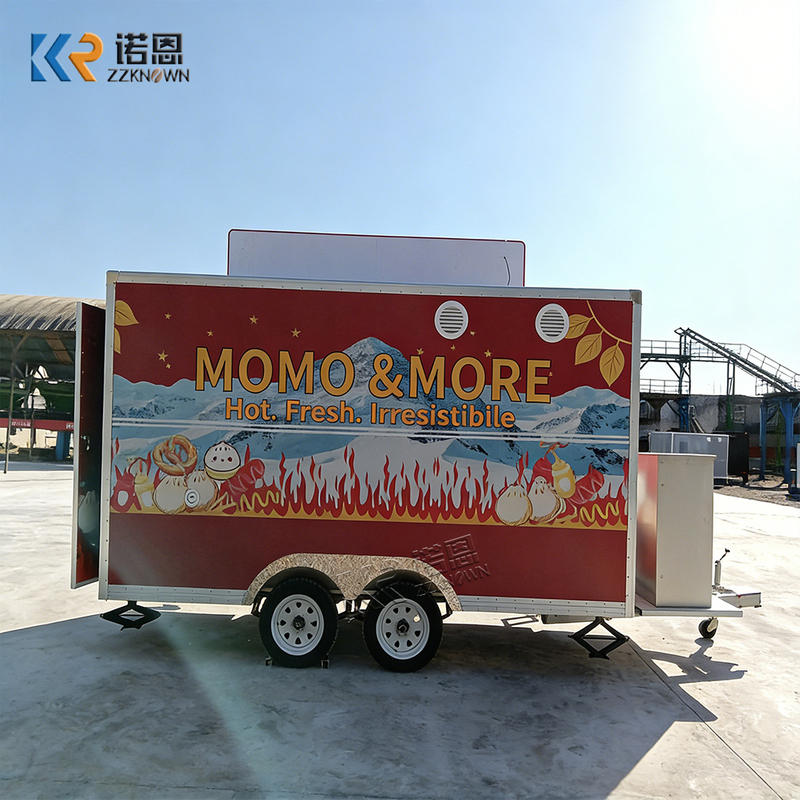
View the real KN-FS-400 trailer product →
Actual product-gallery photo. It shows the trailer and drawbar boxes; it does not prove the cabinet's internal construction or local inspection status.
Another relevant example is ARTEX's 5.8 m stainless Airstream-style mobile kitchen. The published project description lists a dedicated gas cylinder box, gas cooking equipment and a four-valve gas pipeline. It also describes a fire-suppression system. Those features make the project useful for a multi-appliance discussion, but they should not be read as independent proof that a specific unit has been certified or accepted by a U.S. authority.
For a different compact format, the KN-FS-500 square trailer lists the gas-bottle tank and air vents as customization options. That is exactly why a quote should state whether those options are actually included in your unit, at what dimensions and with what destination review. “Customizable” is not the same as “installed.”
Buyer question | Exterior drawbar box | Body-recessed exterior-access locker |
|---|---|---|
What is the main benefit? | Visible service access and direct outdoor exposure | Can preserve external shape and protect the cylinder from casual contact |
What must be checked first? | Tongue weight, hitch/turning clearance, impact protection | Gas-tight separation from kitchen, fire-resistant construction where required |
Where can ventilation fail? | Grilles blocked by equipment, covers or stored goods | Vents opening into hidden body or chassis cavities instead of outside |
What should the quote include? | Cabinet dimensions, frame attachment, vent detail, restraint and access | Same items plus compartment section, fire separation and penetrations |
This table compares design-review issues, not price or code approval. We did not find a reliable cross-market cost dataset for custom LPG cabinets. Rather than inventing a dollar range, ask for two like-for-like quotations that identify cylinder size, cabinet materials, mounting structure, vent design, regulator/pipe scope, local certification and commissioning. The cheaper box may omit the very items an inspector will ask to see.
Think of this as a five-part package. First, a dimensioned trailer plan showing the cabinet relative to the entry, service window, generator, electrical inlet, hot exhaust and wheel/road-impact zones. Second, a cabinet elevation and section showing cylinder dimensions, restraints, door swing, external vents, compartment separation and any required fire-rated materials. Third, a gas-system schematic identifying regulator, gas pipe, isolation points and appliances. Fourth, a market-specific equipment schedule with appliance model and fuel ratings. Fifth, an approval path: who reviews the design, who commissions it, what records the buyer receives and what is checked after shipment.
Also ask for three photos at the right time: cabinet before cylinders are installed, cabinet with the actual cylinder restrained, and the completed exterior with door closed and vents visible. A beauty shot of the trailer from across a parking lot will not show whether a pipe penetration is sealed or a vent is obstructed. If the builder cannot provide a close-up yet because the trailer is not built, request the drawing now and the photo as a production milestone.
Source and area | Useful buyer point | Limit |
|---|---|---|
Identifies relevant NFPA code families and operator gas-system checks. | Fact sheet, not the adopted local code or approval. | |
Describes separated cylinder compartments, outside access, ventilation and competent service. | Local UK guidance; check your authority's current rules. | |
Illustrated checks for restraint, outdoor ventilation, access, signage and nearby hazards. | Local checklist; dimensions are not worldwide defaults. | |
Explains upright restraint, outdoor storage and heavier-than-air gas behavior. | General cylinder guidance, not a food-trailer approval document. |
If your trailer will operate in the United States, ask the local fire marshal or authority having jurisdiction which editions and amendments apply before ordering. If it will operate in the UK, seek a gas professional competent for mobile catering and the relevant council's requirements. In Australia, ask the state or territory gas regulator and a licensed installer. Other countries and event venues may have their own cylinder quantities, separation distances and documentation rules. A manufacturer can adapt a design to a supplied checklist; it cannot issue the local authority's approval on the buyer's behalf.
We reviewed the current public NFPA food-truck fact sheet, Bradford and Torbay council guidance, WorkSafe Queensland cylinder guidance and live ARTEX product descriptions for the KN-FS-400, KN-FS-500 and 5.8 m Airstream-style trailer. We compared recurring themes—outside access, separation, upright restraint, ventilation and shutoff—and flagged where a source is local rather than worldwide. We did not inspect the physical product units, test a gas installation, calculate vent free area for a particular cabinet or verify a buyer's destination requirements. No anonymous “study” or made-up field measurement is used here.
Author: ZZKNOWN Editorial Team. Technical review status: This general article has not been signed off by a named gas engineer. A destination-qualified gas professional and the relevant fire/gas authority should review the project drawing and installation. Image disclosure: The title image is AI-generated editorial illustration, not a ZZKNOWN project photo or approved engineering detail. The linked KN-FS-400 image is from the real product gallery.
Do not assume so. A simple under-counter cabinet opens into the occupied kitchen and may not meet the local separation, ventilation or access rules. Show the proposal to a qualified local gas professional before ordering. In Bradford's UK guidance, an indoor cylinder needs a specially constructed compartment with an outside door.
No. Its mount, cylinder restraint, vent free area, impact protection, access and proximity to other equipment still need review. A product page showing a box proves only that a box is visible or listed, not that it meets the destination's code.
There is no safe global answer. The allowed number and capacity depend on the destination rules, menu and equipment demand, trailer layout and event conditions. Give the designer the appliance ratings and expected service hours, then ask the local authority and gas supplier to confirm the configuration.
Some UK local guidance, including Torbay's checklist, specifies high- and low-level outdoor vents. Other jurisdictions may use different technical language or calculations. Because LPG is heavier than air, ask the designer to explain the low-level escape route and to document the applicable vent requirements.
Do not plan on it. A generator has heat, exhaust and electrical/ignition issues, while the cylinder cabinet should remain dedicated and ventilated. The KN-FS-400 product page describes separate gas-cylinder and generator boxes on the drawbar; ask for the actual separation detail in your own order.
Torbay's mobile-catering checklist says gas bottles must be turned off in transit. Follow the cylinder and appliance instructions and the rules in your operating jurisdiction. Include the travel/shutdown procedure in staff training and the delivery handover.
A person appropriately qualified in the destination jurisdiction. Ask before shipment which work is factory-installed, what components will be supplied, what remains to be connected locally, and what commissioning, inspection or certificate the local authority requires.
Send your destination city and country, menu, gas-appliance models and ratings, preferred cylinder supplier and dimensions, trailer size, generator requirements, site/event checklist and any local gas or fire guidance. Request a drawing that marks cylinder location, restraints, vents, gas route and shutoffs before the final quotation.
Send ZZKNOWN your destination, menu and gas-equipment list. Ask for a marked cylinder-cabinet drawing, vent and restraint details, the gas-line schematic and a quote showing what is included. Have your local qualified gas professional review it before production.
Request an LPG Cabinet & Gas-Line Layout
Related reading: food trailer kitchen ventilation · electrical-system planning · wastewater-tank layout. These are separate systems; coordinate their locations on one trailer plan.