Views: 7 Author: ZZKNOWN Publish Time: 14-08-2026 Origin: ZZKNOWN


ZZKNOWN ENGINEERING GUIDE
Published: August 14, 2026 | Last Updated: August 14, 2026
Author: ZZKNOWN Editorial Team | Technical Review: ZZKNOWN Electrical Engineering Team
Direct answer
A food trailer may need less than 4 kW for a simple cold-food setup or more than 30 kW for an all-electric hot kitchen. The correct number comes from each appliance nameplate, the equipment that can run at the same time, motor starting current, voltage, phase, and a practical safety margin. Never size shore power, a generator, or a battery from a generic equipment list alone.
Nameplate data beats internet averages. Two appliances that look alike can have very different voltage, phase, and current requirements.
Connected load is not daily energy use. A 14 kW fryer does not necessarily consume 14 kWh every hour, but the electrical system must still be able to support its rated demand.
Heat-producing equipment dominates the load. Fryers, griddles, ovens, espresso machines, and water heaters can use far more power than lights, pumps, POS terminals, or refrigeration.
Motors need special attention. Refrigeration compressors, pumps, exhaust fans, and air conditioners can draw extra current when starting.
Voltage and phase change the current. A 9 kW load is about 37.5 A at 240 V single phase, but current per line is much lower when a suitable three-phase supply is used.
Your destination decides the final design. The venue supply, local code, inspector, utility connection, plug type, earthing system, and equipment approvals must all agree.
This guide is written for buyers in the United States, Canada, Europe, the United Kingdom, Australia, New Zealand, the Middle East, and other export markets. Product specifications and public guidance were checked on August 14, 2026. The examples are for early planning and supplier discussions; they are not permit drawings or final circuit schedules.
Electrical requirements can change with the exact model, production date, voltage option, local code edition, altitude, ambient temperature, cable length, installation method, and the authority having jurisdiction. Before operation, have the final system reviewed and tested by a qualified electrician who understands mobile commercial kitchens.
The story usually starts with a menu, not a spreadsheet. A buyer says, “I want to sell smash burgers, fries, coffee, and cold drinks.” Each item sounds ordinary. Then the equipment list arrives: a commercial griddle, an electric fryer, a coffee brewer, a refrigerator, a freezer, an ice maker, a water heater, an exhaust fan, an air conditioner, lighting, a water pump, and a POS system.
Individually, every appliance seems manageable. Together, they may exceed the capacity of a common event connection or portable generator by a wide margin.
Based on CNREALLY KNOWN's production experience, the safest projects follow a load-first workflow. ZZKNOWN asks for the menu, exact appliance models, nameplate photos, operating sequence, and destination supply before the kitchen layout is frozen. That early conversation can prevent expensive changes to the inlet, distribution board, cable routing, generator compartment, ventilation plan, and counter openings.
Engineer's note
“Do not ask only, ‘How many watts is the trailer?’ Ask, ‘Which loads can be on together, at what voltage and phase, and what happens when the largest motor starts?’ That is the question that produces a useful design.” — ZZKNOWN Electrical Engineering Team
These terms are related, but they do different jobs:
Watts (W) and kilowatts (kW) describe real power at a moment in time. One kilowatt equals 1,000 watts.
Amps (A) describe current. Cable, connector, and breaker decisions depend heavily on current.
Volt-amperes (VA or kVA) describe apparent power. Generator and inverter ratings are often discussed in kVA as well as kW.
Kilowatt-hours (kWh) describe energy used over time. Your utility bill is usually based on kWh, not the appliance's maximum kW rating.
For a simple resistive single-phase load, a first estimate is VA = volts × amps. For three phase, a common planning formula is VA = 1.732 × line voltage × line current. Motors and electronic equipment introduce power factor, efficiency, starting current, and harmonics, so nameplate and manufacturer instructions still take priority.
The table below uses identifiable commercial models and official manufacturer specifications. It is more useful than a generic “typical watts” list because it shows how dramatically equipment choices affect the trailer.
Equipment example | Published electrical data | What it means for planning |
|---|---|---|
115 V, 2.0 A, single phase | About 230 VA while running by simple multiplication, plus compressor-starting considerations; the manufacturer specifies a dedicated 15 A outlet. | |
115 V, 3.5 A; 15 A maximum fuse/HACR breaker | About 403 VA by simple multiplication, but ice production, ambient conditions, and cycling affect daily energy use. | |
Dual-voltage; published 120/240 V configuration is 3,850 W and 17.5 A | A coffee brewer alone can consume more capacity than several refrigerators, lights, and pumps combined. | |
6,008 W at 208 V or 8,000 W at 240 V | Voltage configuration changes both heating output and current. At 240 V single phase, the published nominal current is 33.3 A. | |
14 kW model; official electric tables list multiple three-phase voltage options | One full-size electric fryer can exceed an entire 230 V, 32 A single-phase supply. | |
9 kW; 43.3 A at 208 V single phase or 37.5 A at 240 V single phase | Water heating can quietly become one of the largest loads in the trailer. |
Important: these examples are not endorsements and are not a universal equipment list. They demonstrate why model-specific data matters. A small refrigerator may draw only a few amps while a heating appliance can require tens of amps or a three-phase connection.
We used a straightforward method that a buyer can repeat:
Selected recognizable commercial equipment categories frequently discussed in mobile-kitchen projects.
Used official manufacturer product pages or specification sheets rather than retailer summaries.
Recorded the exact model, voltage, phase, wattage or amperage published by the manufacturer.
Used volts × amps only as a transparent first-pass VA calculation when wattage was not directly stated.
Kept peak connected load separate from daily kWh because thermostats, compressors, recovery cycles, and operating habits change actual energy use.
Checked all linked source pages on August 14, 2026. Manufacturers may revise specifications, so confirm the current sheet before ordering.
Adding every nameplate gives you the total connected load. That is useful, but it may not represent the loads that operate together. A thermostat-controlled griddle cycles. A refrigerator compressor starts and stops. A water heater may recover after a rush. Some operators intentionally prevent two large loads from running together.
The better question is: what is the highest credible simultaneous load during your busiest service period? That load should include equipment that must stay on, equipment likely to heat at the same time, ventilation, pumps, lighting, controls, and realistic starting conditions.
Do not reduce a load on your own because “it probably cycles.” Diversity and demand factors must be applied by someone familiar with the relevant electrical code and actual operating sequence.
Start with one row per electrical item. Photograph the nameplate, then record the values exactly as shown.
Item | Model | Volts | Phase | Watts/amps | Runs with | Dedicated circuit? |
|---|---|---|---|---|---|---|
Griddle | Exact model | Nameplate | 1P/3P | Nameplate | Lunch peak | Verify |
Refrigerator | Exact model | Nameplate | 1P | Running + start data | Always available | Verify |
Hood fan | Exact model | Nameplate | Nameplate | Nameplate | All hot cooking | Verify |
Water heater | Exact model | Nameplate | 1P/3P | Nameplate | Recovery periods | Verify |
Add outlets, signage, lighting, POS, routers, USB chargers, pumps, air conditioning, make-up air, fire-system controls, and any future equipment. Small loads are easy to forget, and several small loads can still matter when the main feeder is near its limit.
Planning example | Theoretical apparent power | Practical interpretation |
|---|---|---|
120 V, 30 A, single phase | 3.6 kVA | Limited electric cooking; more suitable for cold food, drinks, or carefully managed small equipment. |
120/240 V, 50 A, split phase | 12 kVA total at 240 V | Useful for many North American concepts, but large fryers, griddles, and water heaters can still exceed it quickly. |
230 V, 32 A, single phase | 7.36 kVA | A medium supply that requires disciplined appliance selection and load management. |
400 V, 32 A, three phase | About 22.2 kVA | Supports larger balanced loads when the venue, equipment, and local rules allow three phase. |
400 V, 63 A, three phase | About 43.6 kVA | High-capacity event or commercial supply; connection availability must be confirmed before the trailer is built. |
These are mathematical capacities, not recommended continuous operating limits. Breaker rules, conductor ratings, voltage drop, protective devices, power factor, phase balance, ambient temperature, and local demand calculations can all affect the usable design.
Imagine a coffee-focused trailer with a 3.85 kW BUNN brewer, the True undercounter refrigerator, the Hoshizaki ice maker, a small water pump, LED lighting, POS equipment, an exhaust or ventilation fan, and an air conditioner.
The three published appliance examples already total roughly 4.48 kVA before the pump, lighting, fan, air conditioning, or any espresso machine is added. A 120 V, 30 A connection offers only 3.6 kVA in theory, so it would not support that published set. A 120/240 V, 50 A service offers much more room, but the exact circuit arrangement and phase balance still need engineering.
This is why the phrase “coffee trailer” is not an electrical specification. A pour-over bar and a high-volume espresso operation may need completely different supplies.
Now picture a burger-and-fries menu using the 8 kW version of the Star 524TGF griddle, one 14 kW Frymaster RE14 fryer, the True refrigerator, the Hoshizaki ice maker, and a 9 kW Hatco water heater. Those selected models alone represent more than 31 kW of published heating capacity plus refrigeration and ice-making loads.
That combination is far beyond a common 12 kVA, 50 A North American split-phase connection. The buyer would need to reconsider the appliances, use gas for some cooking, select lower-power alternatives, use a suitable larger or three-phase supply, or design a controlled operating sequence approved for the destination.
The point is not that every burger trailer needs 30 kW. The point is that the menu name tells us almost nothing until the actual appliances are chosen.
A sensible first-pass generator discussion starts with the highest credible simultaneous running load, then considers the largest starting load and adds an engineering margin. After that, verify the generator manufacturer's ratings at the expected altitude and temperature, the available single- or three-phase output, voltage regulation, fuel type, noise limits, emissions rules, neutral arrangement, grounding method, connector, and transfer equipment.
A generator advertised as “12,000 watts” may have different running and surge ratings. It may also deliver less useful capacity under hot or high-altitude conditions. Do not select it from the largest marketing number on the box.
For grounding, bonding, and transfer details, read our related guide: How Does a Food Trailer Electrical System Work? OSHA also publishes a concise official guide on portable generator grounding. Local requirements still control the final installation.
Sometimes—but battery sizing must use both power and energy. The inverter must supply the highest simultaneous kW and motor-starting demand. The battery must provide enough kWh for the required operating time after conversion losses, allowable depth of discharge, temperature effects, aging, and reserve capacity are considered.
A coffee or cold-food trailer may be a better battery candidate than an all-electric fry-and-griddle kitchen. High-power heating loads can empty a practical mobile battery bank quickly. Solar panels may extend runtime, but roof area and real sunlight are limited; “solar ready” does not mean “solar can run everything.”
Daily cost depends on energy, not only maximum power. Multiply measured daily kWh by your local electricity price. The table below is illustrative and uses two example tariffs—not claims about any country.
Measured energy per day | At US$0.15/kWh | At US$0.30/kWh | 30-day total at US$0.15–0.30/kWh |
|---|---|---|---|
10 kWh | US$1.50 | US$3.00 | US$45–90 |
20 kWh | US$3.00 | US$6.00 | US$90–180 |
40 kWh | US$6.00 | US$12.00 | US$180–360 |
60 kWh | US$9.00 | US$18.00 | US$270–540 |
Use a suitable submeter or generator monitoring system to measure real operation. Do not estimate monthly cost by multiplying every nameplate wattage by all opening hours; that usually overstates cycling loads and may understate warm-up, recovery, or peak-demand effects.
Yes, especially for equipment that runs many hours. The U.S. ENERGY STAR commercial food-service program reports category-level savings for certified commercial refrigerators, ice makers, fryers, griddles, ovens, and other equipment. Its public guidance says certified commercial refrigerators and freezers are, on average, about 20% more energy efficient than standard models.
Efficiency does not reduce the need to design for the equipment's required supply. It can, however, lower daily kWh, heat rejection, generator runtime, and operating cost. Compare certified models and manufacturer energy data rather than judging efficiency from watts alone.
ZZKNOWN trailer models are customized around destination standards and the approved equipment schedule. Examples include:
KN-FR220B compact 110 V food trailer for lighter coffee, ice cream, and snack concepts.
KN-QF400 U.S.-ready aluminum food trailer with a layout that can be coordinated around a North American equipment list.
KN-FS500 5-meter Australian-market project for a larger multi-equipment kitchen.
KN-FS400 commercial pizza trailer, where oven fuel choice, refrigeration, ventilation, and auxiliary loads must be coordinated early.
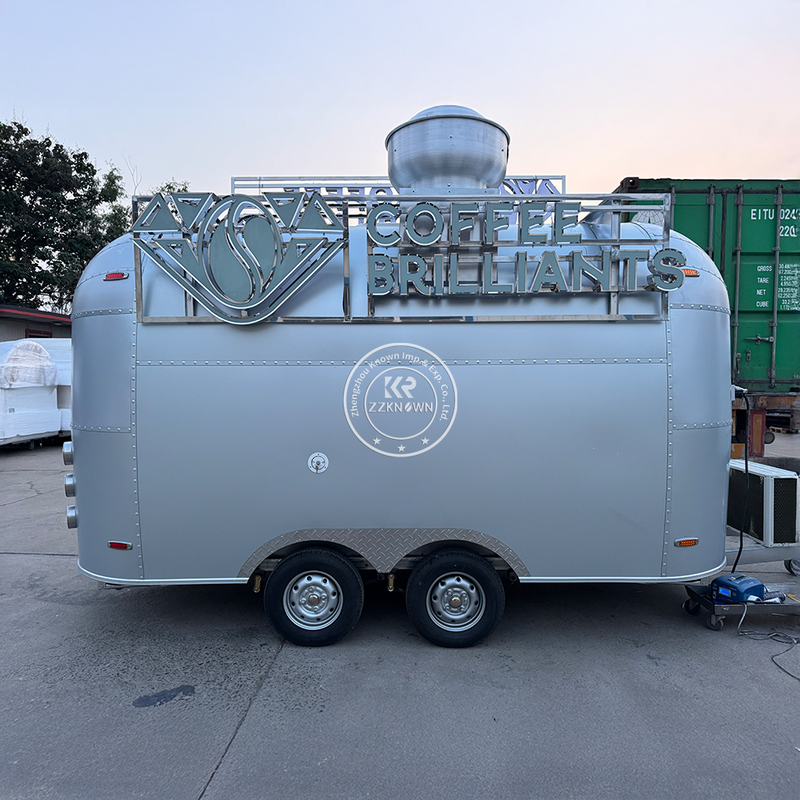
Real project image: ZZKNOWN KN-QF400 U.S.-ready food trailer. Final load depends on the buyer's approved equipment list.
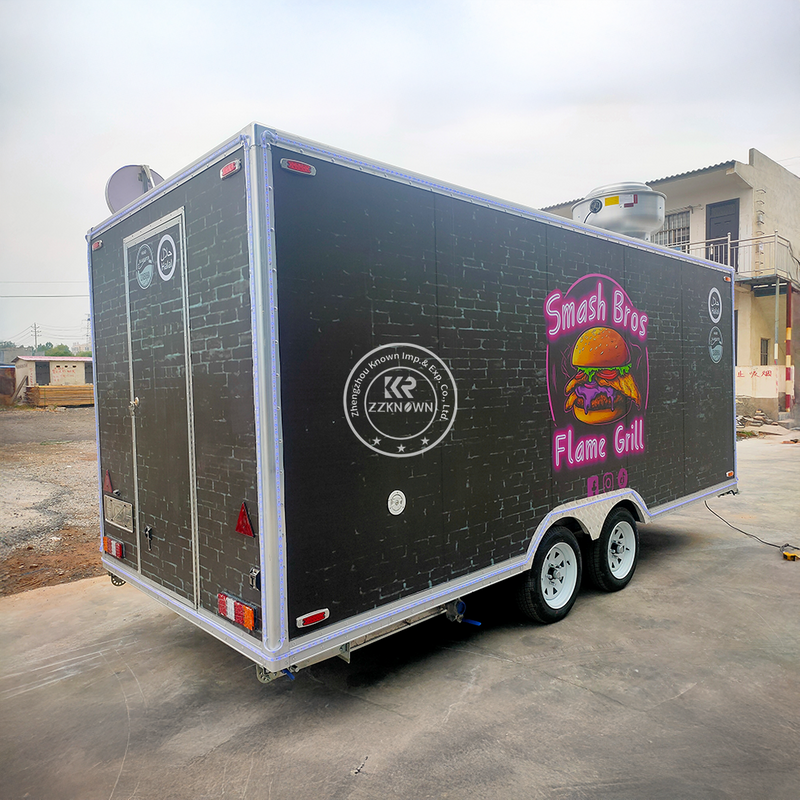
Real project image: ZZKNOWN KN-FS500 Australian-market food trailer.
Send the following information at the quotation stage:
Destination country, city, and operating venues
Available voltage, frequency, phase, current, connector, and venue restrictions
Exact appliance model numbers and clear nameplate photos
Which appliances must operate together during the busiest 15–30 minutes
Shore power, generator, battery, solar, or hybrid preference
Heating and cooling requirements, expected ambient temperature, and altitude
Future appliances you may add within the next three years
Local inspector, fire authority, health department, and electrical approval requirements
ZZKNOWN can then coordinate the preliminary equipment layout, power inlet, distribution space, circuit grouping, generator or battery allowance, and cable routes. The local licensed professional remains responsible for final code compliance and approval.
Useful starting points include the IEC 60364-7-717 requirements for mobile or transportable units, the European Union's Low Voltage Directive 2014/35/EU, OSHA's guidance on ground-fault circuit interrupters, and Standards Australia's listing for AS/NZS 3001.2:2022.
These sources do not replace the rules adopted where you operate. Mobile food businesses may also face venue-specific requirements, fire-code rules, vehicle standards, health regulations, and utility conditions.
There is no single number. The True TUC-27-HC example is rated 115 V and 2.0 A, but larger refrigerators, freezers, prep tables, display cabinets, and different voltage versions vary. Use the exact model's nameplate and account for compressor starting.
It can be enough for a carefully designed low-load concept. At 120 V, 30 A represents only 3.6 kVA in theory. That is not enough for the published 3.85 kW BUNN brewer example by itself. At other voltages, the capacity changes.
Sometimes, especially when cooking uses gas or lower-power appliances. A 120/240 V, 50 A split-phase service provides 12 kVA in theory. One 14 kW full-size electric fryer already exceeds that figure, so an all-electric menu may require a different supply or equipment strategy.
Possible causes include motor starting current, multiple thermostatic loads turning on together, an overloaded branch circuit, incorrect phase balance, voltage drop, loose connections, leakage current, a faulty appliance, or an incorrectly selected protective device. Stop operation and have a qualified electrician diagnose it.
A small travel converter is not a solution for high-power cooking equipment. Frequency, phase, grounding, approvals, current, and connector requirements matter as much as voltage. Order equipment for the destination supply whenever possible.
Both matter. The generator must handle credible simultaneous running demand and the largest realistic starting event without unacceptable voltage or frequency drop. Confirm the manufacturer's continuous and surge ratings and any derating.
Only if the inlet, feeder, panel, protective devices, conductors, ventilation, fire protection, weight distribution, and local approvals support it. Planning spare panel space does not automatically create spare electrical capacity.
Send the destination supply and exact appliance schedule with nameplate photos. That lets the engineering team design around real data instead of placeholders.
Choose your menu, shortlist real appliances, and turn those choices into a load sheet before approving the trailer drawing. If the load is too high, it is much easier to change a fryer, water heater, or power strategy on paper than after production.
Send ZZKNOWN your appliance models, nameplate photos, destination voltage, and expected operating schedule. We will help organize a preliminary load sheet and customized CAD layout for your project.
Request a Power Plan & Layout Design