Views: 550 Author: Yuliya Publish Time: 02-02-2026 Origin: ZZKNOWN


If you’ve ever stood in a European square early in the morning—Rome, Barcelona, Berlin, Amsterdam—you already know something important:
Coffee culture in Europe is serious business.
People don’t just want caffeine.
They want ritual, speed, quality, compliance, and trust.
Over the last decade, we at ZZKNOWN have worked with buyers across Europe—Italy, Spain, France, Germany, the UK, Scandinavia—and one thing is clear:
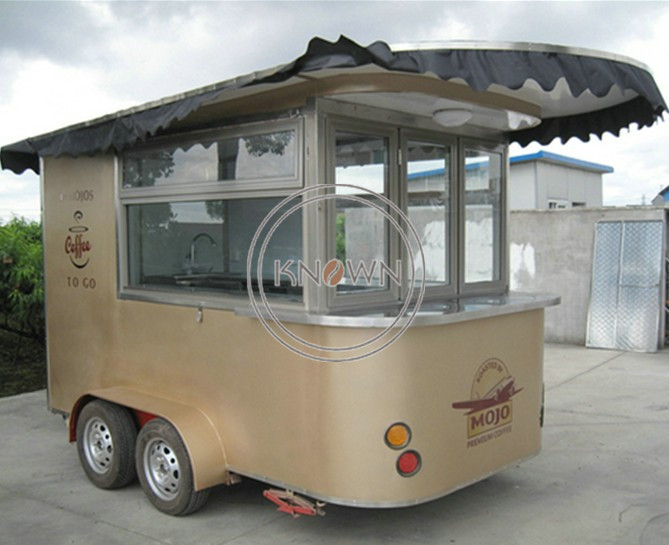
A coffee trailer that works in Europe is not the same as one designed for the US or Australia.
This guide is written like I’d explain it to a friend who’s about to spend real money on their first coffee trailer in Europe.
No fluff. No theory. Just what actually works.
Before we talk about design, let’s talk mindset.
Europe isn’t “emerging coffee”.
Europe is mature coffee culture.
That changes everything.
Espresso quality comparable to cafés
Clean, minimalist aesthetics
Fast service (especially mornings)
Strict hygiene and safety standards
Sustainability awareness
Quiet operation (especially in cities)
If your trailer feels “cheap”, noisy, or non-compliant, customers will notice immediately.

This is the part many first-time buyers underestimate.
Short answer: Yes. Absolutely.
While each country has local rules, most European coffee trailers must comply with:
| Requirement | Why It Matters |
|---|---|
| CE Certification | Mandatory for electrical and mechanical safety |
| Food-grade materials | Stainless steel surfaces, safe plumbing |
| Electrical compliance (220–240V / 50Hz) | European standard |
| Proper ventilation | Health & safety inspections |
| Wastewater & clean water tanks | Environmental regulations |
| Fire safety setup | Especially for LPG or electric systems |
At ZZKNOWN, all coffee trailers are designed with CE compliance in mind, not added later as an afterthought.
Personal experience:
We’ve had customers rejected by local inspectors simply because wiring labels were missing—even though the equipment itself was fine.
Here’s the truth most suppliers won’t tell you:
Bigger is not better in Europe.
| Size | Best Use Case |
|---|---|
| 2.2–2.5m | Tight city centers, markets, festivals |
| 2.8–3.0m | Most popular “sweet spot” |
| 3.5m+ | Events, private catering, suburban areas |
Easy to tow with standard vehicles
Lower permit friction
Faster setup and teardown
Lower energy consumption
Enough room for 1–2 baristas
From our sales data at ZZNOWN, over 65% of European buyers choose trailers under 3 meters.

Let me say this clearly:
Workflow matters more than decoration.
This is the most efficient layout we’ve seen across Europe.
Barista stands in one position
Espresso machine directly in front
Grinder to one side
Fridge and milk below
Sink behind or adjacent
No walking. No turning around constantly.
Just smooth, fast service.
| Component | Placement |
|---|---|
| Espresso machine | Front counter |
| Grinder | Side of machine |
| Under-counter fridge | Below |
| Sink & water system | Rear |
| Storage | Upper cabinets |
This design reduces fatigue and increases speed—critical during European morning rushes.
Forget Instagram trends. Let’s talk reality.
Nuova Simonelli
La Spaziale
Rancilio
Faema
Single-group machines dominate mobile setups because they:
Heat faster
Use less power
Are easier to maintain
At ZZNOWN, we design trailers that support both single and dual-group machines, depending on power availability.
This depends heavily on country and city.
Pros
Easier permits
Cleaner operation
Accepted in most cities
Cons
Requires sufficient amperage (often 32A)
Used in:
Rural markets
Event catering
Countries with flexible gas regulations
Real-world note:
Many cities in Europe are restricting gas use, so electric-ready trailers are more future-proof.
Very important—but not loud.
Europeans prefer:
Neutral colours
Wood textures
Matte finishes
Minimal branding
| Element | Recommendation |
|---|---|
| Colour | White, black, grey, olive |
| Materials | Stainless steel + wood |
| Lighting | Warm LED (not bright white) |
| Logo | Simple, readable, small |
One customer in Germany told us:
“People trust us more because the trailer looks calm, not aggressive.”
This is no longer optional in Europe.
Low-energy appliances
LED lighting
Water-saving faucets
Compostable cup storage
Optional solar support
Some municipalities even prioritize eco-friendly vendors during event selection.

Let’s be realistic.
| Item | Typical Cost Range |
|---|---|
| Trailer shell & fit-out | €4,000 – €7,000 |
| Espresso machine | €1,500 – €3,000 |
| Grinder & fridge | €800 – €1,500 |
| Compliance & permits | €500 – €1,500 |
A serious European coffee trailer setup usually lands between €7,000 and €12,000, depending on country and equipment.
A Spanish customer chose:
2.8m trailer
Single-group machine
Simple menu
Minimal design
Break-even: under 7 months
A buyer insisted on:
Oversized trailer
Dual-group machine
Over-complex menu
Result:
Power issues
High operating cost
Slow service
Lesson: Design for reality, not ego.
Here’s a checklist we always give our clients:
Is the trailer CE-ready?
Is wiring labeled and documented?
Does it support 220–240V / 50Hz?
Is the layout inspector-friendly?
Can it be upgraded later?
At ZZNOWN, we provide 2D & 3D drawings before production, so there are no surprises.
Yes—but permits are local. Always check with your municipality.
Yes. Many do. But CE compliance is non-negotiable.
Yes—especially in high-footfall areas. Many operators break even within 6–10 months.
Depends on country. Some require shared kitchens; others allow onboard prep.
If designed correctly, yes. Modular design matters.
I would:
Start small
Focus on espresso quality
Keep the menu tight
Design for inspectors, not Instagram
Choose a supplier who understands Europe
That’s exactly how we build coffee trailers at ZZKNOWN.