Views: 692 Author: ZZKNOWN Editorial Team Publish Time: 16-10-2026 Origin: ZZKNOWN


Published: October 16, 2026 | Last Updated: October 16, 2026 | Reading Time: 17 minutes
Direct answer: Choose hot-holding equipment by the food’s moisture, crust and planned holding time—not by menu name alone. Use humid holding or a covered bain-marie for dumplings, curries and sauced fillings; dry heated cabinets or short heat-lamp staging for crisp samosas, empanadas and spring rolls. Whatever the format, verify the food itself stays above the temperature required by the operating market and local authority.
Start with food quality. A safe temperature does not guarantee a crisp shell, moist filling or fresh-looking garnish.
Cooking, reheating and holding are different jobs. Do not expect an ordinary holding cabinet to heat cold food rapidly unless it is specifically designed and accepted for that purpose.
Measure food temperature. A glowing heat lamp or warm cabinet display is not proof that the center of the food is safely held.
Use smaller batches. Frequent replenishment usually protects texture better than loading a deep pan for an entire service period.
Match humidity to the menu. Moisture helps dumplings and sauced foods but can soften fried wrappers, pastry and bread.
Confirm destination rules. The United States, United Kingdom and Australia use different hot-holding baselines, and local adoption or enforcement controls the final design.
Where and when does this guide apply? This article is written for global buyers planning food trailers for the United States, United Kingdom, Australia and other markets. Official food-safety sources, equipment standards and live ZZKNOWN product pages were reviewed on October 16, 2026. It is a procurement and layout guide, not a HACCP plan, equipment certification, menu shelf-life validation or guarantee of local approval.
Picture the busiest twenty minutes of a festival lunch. One customer orders steamed dumplings, another wants a crisp samosa, and a third asks for two glazed chicken skewers. The team has already cooked a batch, the line is growing, and every product is waiting somewhere between the cook line and the serving window.
This is where a small equipment decision becomes a menu decision. Put dumplings under strong dry heat and the wrappers can toughen. Put fried samosas in a humid steam table and the crust can soften. Hold assembled mini burgers too long and the bun can absorb steam and sauce. The equipment may be hot, but the food can still disappoint.
Based on CNREALLY KNOWN’s production experience, buyers often ask for “one warmer” before they have defined the food, batch size or holding time. That is a recurring design-review pattern—not a fabricated customer story or personal experience. A more useful request is: “We need to hold 40 steamed dumplings for up to 20 minutes, 30 fried samosas for up to 15 minutes and two pans of curry sauce during a three-hour event.” Now an engineer can discuss humidity, pan depth, recovery, access and electrical load.
Small portions and global flavors are not just menu decoration. The Institute of Food Technologists’ 2026 trend review cites an Alvarez & Marsal restaurant survey in which 58% of respondents said grabbing a quick snack or small bite was an important reason for restaurant visits. The National Restaurant Association’s 2026 culinary forecast, based on insights from hundreds of culinary professionals surveyed in October 2025, also highlights global comfort and creative flavor combinations.
For a mobile kitchen, that demand creates an operational challenge. Bite-sized items are quick to sell, but their surface-area-to-volume ratio is high. They can cool, dry or absorb moisture faster than a deep pan of stew. Their value often depends on contrast: crisp outside and soft inside, glossy sauce and firm skewer, tender wrapper and hot filling. Holding equipment has to protect both safety and that contrast.
The correct number depends on where the trailer operates. Do not copy a temperature from a U.S. article into a British or Australian food-safety plan without checking the local rule. The comparison below is a planning baseline, not a substitute for the authority having jurisdiction.
Market | Official planning baseline | What the buyer should confirm |
|---|---|---|
United States | FDA Food Code 2026 section 3-501.16 uses 57°C / 135°F or above for hot holding of TCS food, subject to stated exceptions | Which Food Code edition and local mobile-unit rules the state or city has adopted |
United Kingdom | Official guidance says hot food not served immediately must be kept at or above 63°C, with controlled exceptions | Applicable national rules, time controls and Environmental Health Officer expectations |
Australia | Potentially hazardous food should generally be 5°C or colder or 60°C or hotter unless a safe alternative system is demonstrated | State or territory requirements, local council review and any required food-safety program |
For the United States, see the 2026 FDA Food Code and FDA’s current edition page. FDA calls the Food Code a model offered for adoption, so it does not automatically prove the rule in every city. For Britain, the GOV.UK food hygiene guidance states that hot food must be kept at or above 63°C if it is not served immediately. For Australia, FSANZ temperature-control guidance explains the 5°C-or-colder and 60°C-or-hotter baseline.
Important distinction: these are food-temperature controls. A cabinet thermostat, steam-table dial or heat-lamp wattage does not replace probing the food. The FDA Food Code also places temperature-measuring devices in the coldest part of hot-holding equipment when an integral device is practical, while recognizing that some designs—such as heat lamps, bain-maries and steam tables—do not make an ambient device a practical substitute for direct food checks.
No single warmer is best for every street-food menu. Think in terms of heat transfer, humidity, access and batch depth. The following table compares the main options a buyer may discuss with the trailer engineer and local reviewer.
Equipment type | Heat / moisture behavior | Good starting applications | Main limitation |
|---|---|---|---|
Wet bain-marie / steam table | Gentle pan heating with a humid environment | Curries, sauces, braised fillings, rice dishes and some covered dumplings | Steam can soften fried crusts and pastry |
Dry hot well | Heated pan well without a water bath | Covered cooked proteins, fillings and lower-moisture foods | Can create uneven or drying conditions if pans and settings are mismatched |
Heated holding cabinet | Enclosed heat; some models offer humidity control | Backup batches, covered pans, dumplings, skewers and assembled orders awaiting dispatch | Large door openings and overloading reduce recovery; humidity capability varies |
Heat lamp / pass shelf | Radiant top heat with an open, dry environment | Very short staging of fried snacks, fries, skewers or plated orders | Not a universal long-term holding solution; exposed surfaces dry quickly |
Heated drawer | Enclosed conductive and convective heat in shallow drawers | Small batches of cooked fillings, wrapped items or proteins | Drawer depth and airflow may not suit bulky products |
Insulated transport box | Passive retention; no active recovery unless powered | Moving preheated pans from commissary to trailer or between event zones | Temperature falls with time and door opening; requires validated loading and monitoring |
In the United States, buyers can use NSF’s food-equipment standards overview as one procurement reference. NSF/ANSI 4 covers minimum food-protection and sanitation requirements for commercial cooking, rethermalization, powered hot-food holding and transport equipment. The current 2025 edition was announced in January 2026. A standard’s scope does not mean every product bearing a familiar shape is certified; verify the exact manufacturer and model in the relevant listing and confirm what the local authority accepts.
The food name gives only a starting point. Recipe, wrapper thickness, filling, sauce, oil content, batch depth and service speed all matter. Test the actual recipe at the target holding temperature before freezing the kitchen layout.
Food | Starting equipment choice | Quality risk to test | Better operating habit |
|---|---|---|---|
Steamed dumplings / bao | Covered humid cabinet or carefully managed steam table | Drying, tough wrappers or condensation making surfaces sticky | Use shallow batches and replenish frequently |
Samosas / spring rolls | Dry cabinet or short heat-lamp staging | Steam softening the crust; dry heat toughening the filling | Cook smaller batches and avoid deep covered piles |
Empanadas / hand pies | Dry holding cabinet with controlled airflow | Pastry drying while moist filling creates a soft bottom | Use racks or shallow pans and establish a tested maximum quality time |
Glazed meat skewers | Covered heated cabinet or shallow covered pan | Drying, sauce scorching or uneven center temperature | Separate cooked batches and verify the thickest piece with a probe |
Mini sliders | Hold protein separately; assemble near service | Soggy bun, wilted garnish and sauce migration | Delay final assembly instead of holding the complete sandwich |
Curry, dhal or sauced filling | Wet bain-marie with suitable covered pans | Surface drying, skin formation or scorching | Stir safely, keep lids managed and avoid topping new food onto old without a procedure |
This table is a product-development guide, not a validated shelf-life claim. Your operator should run a controlled test using the real recipe, pan, portion size, loading pattern and thermometer. Record temperature and sensory changes at defined intervals. If a food stays safe but no longer meets the brand’s quality standard, shorten the holding time or change the process.
A wet bain-marie surrounds food pans with warm water and tends to create a more humid environment. That is useful for foods that benefit from gentle heat and moisture: curry, beans, sauce, braised fillings and some steamed products. It is less friendly to anything whose selling point is a crisp shell.
The practical variables are pan size, water level, preheating, lid use, food depth, product temperature at loading and how often the pans are opened. A deep pan of cold food is not “fixed” by turning the bain-marie higher. Hot-holding equipment is generally for maintaining temperature, not performing a rapid reheating step unless the unit is specifically rated and used for rethermalization.
Dry holding can preserve a fried or baked exterior better than a humid well, but it trades moisture for crispness. The longer the hold, the more likely pastry edges, meat surfaces and bread will dry. Air movement in a cabinet can increase that effect. A heat lamp is even more exposed: it is excellent for a short pass between cooking and pickup, but it should not become an undefined parking place for food.
Design the workflow so a heat lamp is visible to the cook and server. Use a ticket or time-marking system. Avoid stacking different batches. Provide a safe landing area that is not under the service window’s outside airflow, beside raw-food preparation or in the path of customer-facing contamination.
A cabinet may physically fit ten pans, but filling all ten at once can challenge recovery, obstruct airflow and create slow service. Likewise, a four-pan steam table may be wasted space if the menu sells one hot sauce and three crisp products. The right capacity is the number of portions that can be held safely and sold before quality declines—not the maximum volume that fits behind a door.
Ask the supplier how the equipment behaves after a door opening, after a full loading event and at the destination voltage. Ask for rated power, circuit requirements, plug type, clearances, drainage or fill requirements, ventilation implications and exact external dimensions. Add those loads to the food trailer’s electrical calculation before approving the panel and shore-power connection.
Planning parameter | What to send the engineer | Why it changes the layout |
|---|---|---|
Food and process | Recipe family, cooking method, desired texture and whether food is sauced | Determines humid versus dry holding |
Peak batch | Portions per batch and orders per 15 minutes | Determines pan count, door openings and replenishment space |
Target hold | Safety control plus tested quality limit | Determines whether a pass shelf or cabinet is appropriate |
Pan / tray format | Exact GN or fractional pan size, depth, lids and racks | Controls usable capacity and worktop cut-out |
Electrical data | Nameplate voltage, phase, rated watts / amps and plug | Controls circuit, shore power and generator planning |
Cleaning / service | Removable parts, drains, fill point and maintenance clearance | Controls sink path, aisle width and access panels |
The holding station should sit between final cooking and service without crossing raw-food movement or dish return. A cook should be able to place a finished batch into the correct pan, verify temperature and close the lid without stepping through the cashier’s position. A server should retrieve the portion without reaching over a fryer or opening a cabinet into the main aisle.
Place the thermometer, timer and batch labels where staff will actually use them. Provide a landing shelf for the probe and sanitizer procedure required by the operator. Confirm that cabinet doors, pan lids and heat-lamp shades do not collide with the serving-window cover, overhead cabinets or exhaust hood. During CAD review, draw the door swings and the hands of two workers, not just the equipment rectangles.
Real product pages make the design conversation more concrete. The ZZKNOWN 4-meter dual-axle UK food trailer publishes a configuration that includes a soup bain-marie and two heat lamps. That is a useful example of combining moist holding and short dry staging in one trailer, but the equipment list alone does not prove it fits every menu or local approval.
The KN-FS400 U.S.-style square food trailer lists four insulation boxes with fryers, a grill, refrigerator and workbench. A buyer should ask whether those boxes are active or passive, what pan sizes they take, how temperatures will be monitored and how the batch travels from fryer to holding to service.
A third reference is the published 5-meter Australian food-trailer project, whose equipment list includes a soup bain-marie station. Treat it as a layout reference from the website—not as proof of a buyer’s sales results or a universal Australian approval.
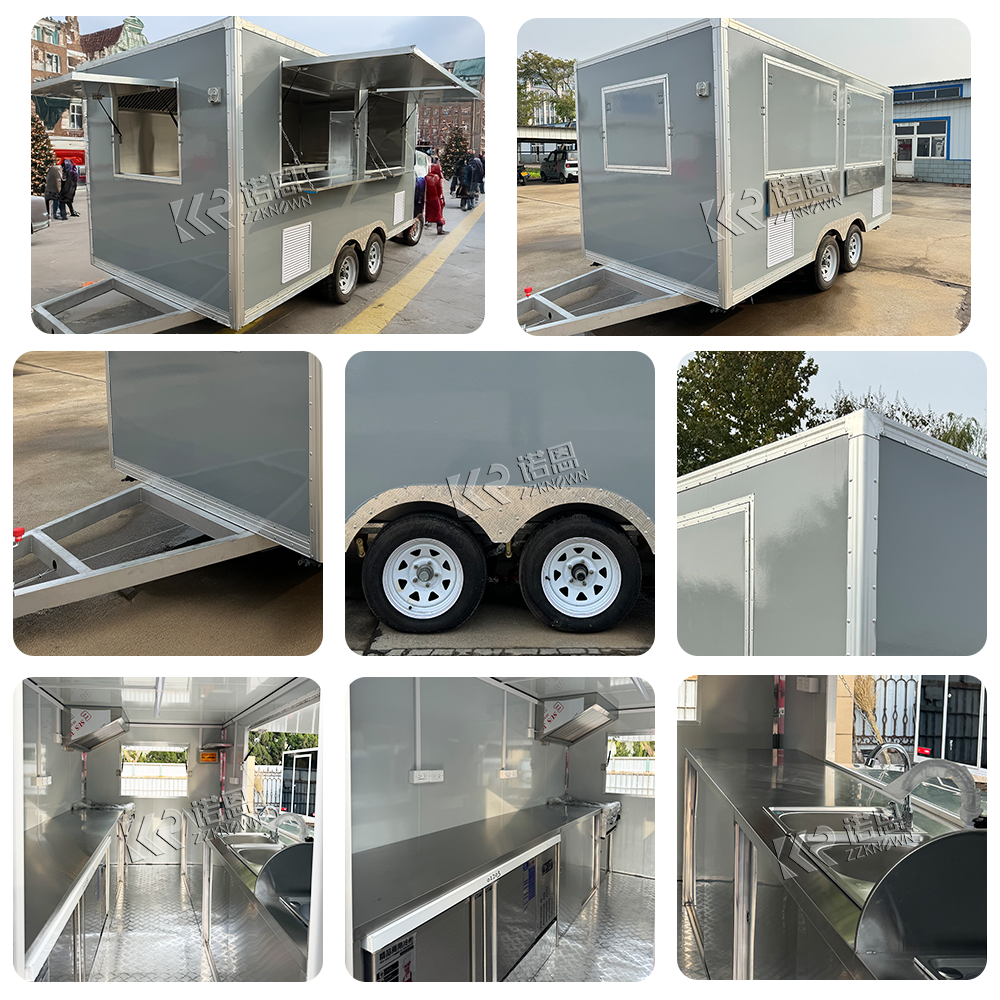
Real ZZKNOWN project image: use the actual aisle, counter and door positions to test a holding station. This photo is a layout reference, not evidence of a specific food’s validated holding time.
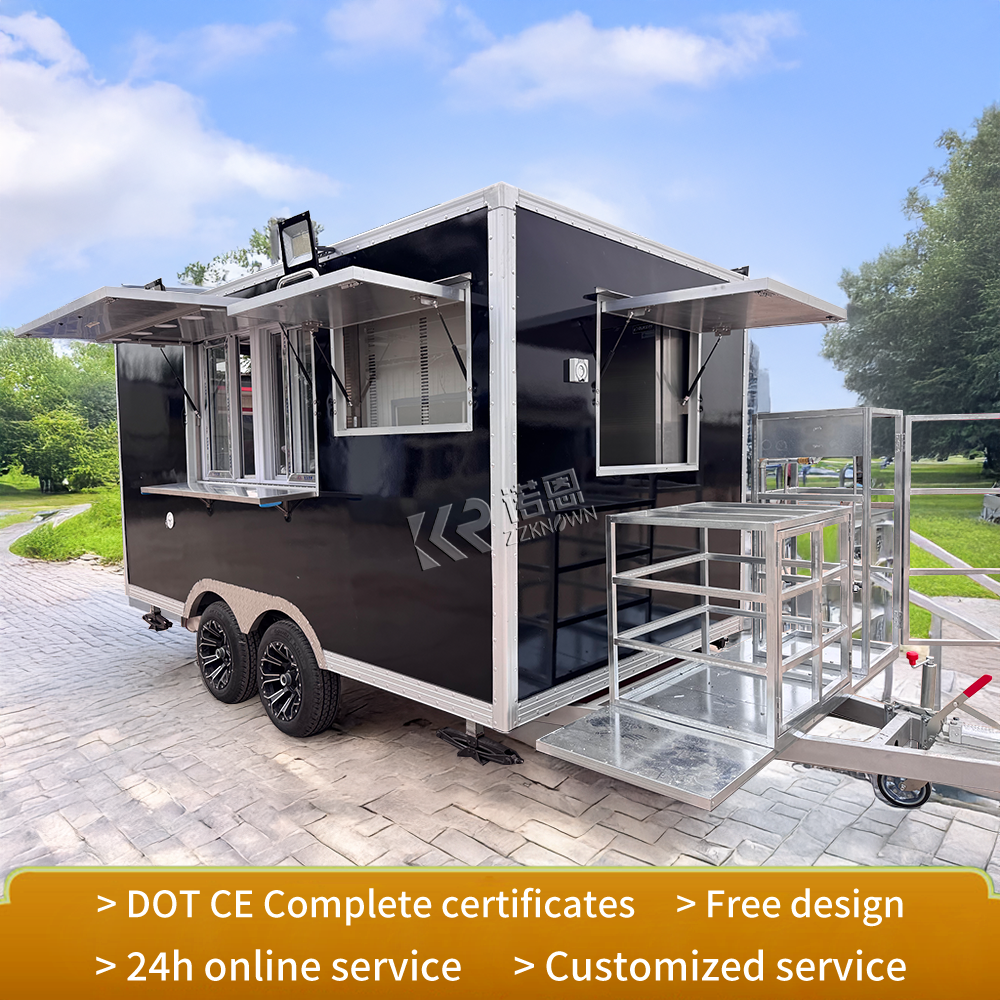
Real ZZKNOWN burger-trailer image: compact service lines make batch size, door swing and pass-shelf location critical. Final holding equipment must match the operator’s menu and destination rules.
Engineer’s note: Based on CNREALLY KNOWN’s production experience, “add a warmer” is not enough information. A useful brief lists each hot food, cooking equipment, portion size, peak orders, desired holding time, pan format, target market, power supply and whether the food needs humidity. It should also identify which items are assembled only after the customer orders.
Send the exact equipment data sheet when possible. Ask for a dimensioned elevation showing counter cut-outs, lid clearance, cabinet door swing, heat clearance, ventilation relationship, electrical circuit, drain or water-fill point and cleaning access. Then test a full service sequence: cook, transfer, probe, cover, time-mark, retrieve, assemble and serve.
For an imported trailer, also separate three questions: Is the holding appliance certified or accepted for the target market? Is the trailer’s electrical and ventilation system designed for it? Does the operator have a food-safety procedure that controls time and temperature? A “CE,” “NSF” or other mark on one component cannot answer all three.
Data collection method: We reviewed the FDA’s 2026 Food Code and current edition page; official GOV.UK and Food Standards Agency hot-holding guidance; FSANZ temperature-control guidance; the FDA list of American National Standards for food equipment; NSF’s food-equipment standards overview; the National Restaurant Association 2026 culinary forecast; and Institute of Food Technologists trend reporting. We compared those sources with live ZZKNOWN/ARTEX pages for the UK 4-meter trailer, KN-FS400 and a published 5-meter Australian project. Sources and product pages were checked on October 16, 2026. No equipment certification, inspection approval, sensory shelf life, buyer testimonial or sales result was invented.
Author: ZZKNOWN Editorial Team. Technical review: CNREALLY KNOWN Kitchen Layout & Food Trailer Engineering Team. The operator, equipment supplier and local authority must validate the final cooking, reheating, holding and monitoring process.
It may maintain temperature, but it may not protect the quality of all three foods. Curry benefits from humid holding; samosas usually do not. Separate moist and dry products, or use different equipment and smaller batches.
A heat lamp can be useful for very short staging, especially for crisp foods, but do not assume it maintains the center of every product at the required temperature. Validate the food, distance, load and time, and follow local rules.
Only if the exact unit is designed and approved for rethermalization and the process meets applicable reheating requirements. Ordinary holding equipment is intended to maintain already-hot food, not slowly warm cold food through unsafe temperatures.
Use the equipment display as an operating signal, but verify the food with an appropriate calibrated probe according to the food-safety plan. Air temperature and product temperature are not interchangeable.
There is no universal number. Recipe, oil, crust, cabinet humidity, airflow, stacking and temperature all matter. Run a documented quality test and set a shorter operating limit than the point where the product becomes unacceptable.
If the menu combines sauced or steamed foods with crisp fried products, two holding environments may be useful. A focused menu may need only one. Compare menu mix and peak batch size before giving up counter space.
Use the exact nameplate data for every proposed unit, then calculate simultaneous demand and startup considerations with the full kitchen. Do not copy a generic wattage from another model or market voltage.
ZZKNOWN can help design equipment placement and utility connections around the stated process. The operator must validate recipe-specific time, temperature and quality limits with the equipment supplier, food-safety professional and local authority.
Create a one-page “cook-to-serve map.” For every menu item, write the cooking step, transfer container, holding environment, maximum operating time, temperature check, assembly step and serving point. Circle any place where a crisp product enters a humid zone or where a server must cross the raw-food or warewashing path.
Then run a peak-period calculation. If forty customers arrive in fifteen minutes, how many portions must be hot, how often will the cabinet open and how quickly can the cook replenish it? That number—combined with the tested quality time—should determine equipment capacity.
Want a holding layout built around your actual menu?
Send ZZKNOWN your operating country and city, menu, portions per peak hour, desired holding time, pan sizes, equipment data sheets and available power. We can prepare a dimensioned CAD option showing wet and dry holding zones, cook-to-serve workflow and an itemized equipment plan. Local acceptance and recipe validation remain the buyer’s responsibility.
Request a hot-holding layout and quote →
Continue planning with these ZZKNOWN guides: food trailer equipment power consumption, electrical load calculation, thermometer placement and calibration, and the ventilation system guide.