Views: 661 Author: ZZKNOWN Publish Time: 02-09-2026 Origin: ZZKNOWN


Published: September 2, 2026 | Last Updated: September 2, 2026 | Reading Time: 15 minutes
Direct answer: Put a visible air thermometer in the warmest part of every refrigerator and the coolest part of every hot-holding unit. Keep a clean, accurate digital probe within easy reach for checking the center of food, not just the equipment. Calibrate it regularly and whenever it is dropped or gives a suspicious reading. Local food rules determine the exact limits and records you need.
Equipment temperature is not food temperature. A refrigerator display tells you about the unit; a sanitized probe verifies the food itself.
Measure the worst-case location. In U.S. FDA model guidance, a refrigerated-unit sensor monitors the warmest area, while a hot-holding sensor monitors the coolest area.
Infrared is a screening tool. It is fast for surfaces and packaged deliveries, but it cannot read the center of a burger, chicken breast, sauce pan or chilled ingredient tub.
Accuracy must be specified. FDA model requirements call for food thermometers accurate to ±1°C or ±2°F in their intended range; Australia requires ±1°C for potentially hazardous food.
Plan mounting and storage before fabrication. A display that is hidden behind a refrigerator or a probe stored beside cleaning chemicals will not support a practical inspection routine.
Use local limits. Cold-holding, hot-holding, cooking, cooling and reheating rules differ by jurisdiction and process.
Where and when does this guide apply?
This guide is for global food-trailer buyers and operators. Regulatory and product information was reviewed on September 2, 2026, with examples from the United States, European Union and Australia. It is a design and operating guide, not a substitute for an approved food-safety plan or written instructions from your local health authority.
A customer can spend weeks choosing a fryer, refrigerator and stainless workbench, then treat the thermometer as a small accessory to buy after delivery. That order feels natural—but it misses how a real mobile kitchen operates.
Picture a lunch rush. The refrigerator door has opened twenty times. Fresh prep has just been loaded. A pan of sauce is sitting in hot holding. Thin burger patties are cooking quickly, and the service window is filling the trailer with warm outside air. The number on one equipment display cannot answer every food-safety question in that scene.
Based on CNREALLY KNOWN’s production experience, temperature monitoring works best when it is designed as a small system: fixed air displays for equipment, a fast food probe for product checks, accessible storage, a cleaning method, calibration records and a simple log that staff can actually complete during service.
Why take it seriously? The U.S. Centers for Disease Control and Prevention estimates that foodborne illness causes 48 million illnesses, 128,000 hospitalizations and 3,000 deaths in the United States each year. A thermometer does not replace hygiene, approved sourcing or time control, but it turns an assumption—“this feels cold” or “that looks cooked”—into a measurement.
Most trailers need more than one type because the devices answer different questions.
Device | What it measures | Best use | Main limitation | Buying priority |
|---|---|---|---|---|
Digital thermistor probe | Internal food temperature | Routine cooking, holding, cooling and receiving checks | Response speed and tip length vary | Essential |
Thermocouple probe | Internal or surface temperature with interchangeable probes | Fast checks and thin foods | Usually costs more | High for busy cook lines |
Bimetal dial probe | Internal temperature averaged along a larger sensing area | Thick roasts, soups and deep products | Slower and poor for thin patties | Menu-dependent |
Infrared thermometer | Surface temperature | Fast screening of packaged deliveries and surfaces | Cannot verify a food’s center | Useful supplement |
Refrigerator / freezer air thermometer | Ambient air or simulated product temperature | Continuous unit monitoring | Does not prove actual food temperature | Essential where required |
Data logger / remote sensor | Temperature over time | Overnight monitoring, transport and alarm records | Needs correct placement, setup and battery discipline | Optional upgrade |
For a small coffee or dessert trailer, one accurate digital probe plus visible thermometers in each refrigeration unit may be enough. A burger, chicken, BBQ or catering trailer may benefit from two probes—one in use and one cleaned backup—plus a data logger for high-value chilled stock.
Not at the coldest point. That location can create a reassuring number while food near the door or at the top of the cabinet is warmer.
Section 4-204.112 of the FDA Food Code 2022 says the sensor in a mechanically refrigerated unit should measure air temperature or simulated product temperature in the warmest part of the unit. The display should be easy to view. In many undercounter refrigerators, a practical starting point is near the front or upper area, away from the direct cold-air discharge—but the equipment manufacturer’s design and local inspector should guide the final position.
Do not block the sensor behind dense food containers. Avoid mounting it where the probe touches a cold metal wall, evaporator surface or ice. Those points may read the equipment surface instead of the storage environment. If the manufacturer provides an integral display, ask what its sensor measures and where it is located.
Most importantly, verify with food. After a delivery, during a heat wave or when the door has been open repeatedly, use a sanitized probe between two sealed packages or in an approved product-simulating medium, then check the actual food if needed under your plan.
For hot holding, the logic reverses: monitor the coolest part. A bain-marie can be hotter near its heat source and cooler at the edge, in a shallow corner or after a fresh pan is added. The FDA Food Code uses the coolest part of a hot food storage unit as the sensor location.
An integral equipment gauge is useful, but it does not replace checking the food. Water temperature in a bain-marie and food temperature in a deep pan are not always the same. Stir products where the recipe permits, avoid overfilling, close lids when appropriate and verify separate pans with a clean probe according to your monitoring schedule.
The goal is to find the area that is slowest to heat or cool, usually the thickest part or geometric center. The USDA Food Safety and Inspection Service thermometer guide recommends avoiding bone, fat and gristle because they can distort the reading.
Thin burger patties, sausage or chicken breast: insert the probe from the side so the sensing tip reaches the center.
Thick meat, roasts or dense items: check the thickest area and more than one point if the shape is irregular.
Soups, sauces and chili: stir where appropriate, then measure in the center without touching the pan.
Large batch cooling: measure the warmest portion and follow the locations and time intervals in your food-safety plan.
Packaged chilled deliveries: place a clean probe between packages for a non-destructive screening check; measure product directly when your procedure requires it.
Probe sensing areas differ. A thermocouple may read near its tip, while a dial bimetal stem may average temperature over a longer section. Read the device instructions and choose a thin-tip model for patties, fish fillets and other shallow food.
USDA reported a useful behavior gap in a 2023 study: 50% of observed participants used a thermometer on a sausage patty, but 92% of those users placed it incorrectly. Owning a thermometer is not enough; placement is part of the method.
No. An infrared “gun” reads emitted energy from a surface. It is excellent for quick comparisons—checking whether delivered cartons are obviously warm, scanning a cold table or finding an uneven hot-holding zone. It cannot see through packaging or measure the center of food.
The Food Standards Australia New Zealand thermometer guidance makes the distinction clearly: infrared thermometers are useful for surface checks, while fixed equipment gauges measure the unit; a probe is normally the best tool for actual food temperature.
Shiny stainless, steam, frost, distance and the device’s field of view can affect infrared readings. Use IR to screen, then use a cleaned and sanitized probe to make the food decision.
Reference region | Food thermometer accuracy | Ambient air / water accuracy | Important note |
|---|---|---|---|
U.S. FDA Food Code 2022 | ±1°C for Celsius/dual-scale; ±2°F for Fahrenheit-only devices | ±1.5°C for Celsius/dual-scale; ±3°F for Fahrenheit-only devices | Model code; confirm local adoption and amendments |
Australia Standard 3.2.2 | ±1°C for measuring potentially hazardous food | Check device purpose and local enforcement | At least one accurate, accessible thermometer is required for businesses handling potentially hazardous food |
European Union | No single accuracy number for every mobile-food task in Regulation 852/2004 | Equipment and arrangements must support suitable temperature conditions and monitoring | Member-state, product and HACCP requirements apply |
Accuracy and resolution are different. A display that shows 0.1°C increments is not automatically accurate to 0.1°C. Ask for the manufacturer’s stated accuracy across the range you will use, not only at room temperature.
Use the limits in your approved local process. The examples below help buyers understand the range a device may need to cover; they are not one global operating rule.
Example benchmark | Temperature | Source / use |
|---|---|---|
U.S. FDA model cold holding | 5°C / 41°F or below | TCS foods under Food Code 2022, subject to local adoption |
U.S. FDA model hot holding | 57°C / 135°F or above | TCS foods under Food Code 2022, subject to local adoption |
Australia general potentially hazardous food benchmark | 5°C or colder, or 60°C or hotter | FSANZ guidance unless another safe process is demonstrated |
USDA poultry cooking example | 74°C / 165°F | Consumer/food-service planning reference; local retail rules and time-temperature combinations govern |
USDA whole cuts of beef, pork, veal and lamb | 63°C / 145°F plus 3-minute rest | Safe minimum internal temperature chart |
Read the official USDA safe minimum internal temperature chart for product-specific U.S. guidance, then reconcile it with the food code adopted by your local authority and your approved recipes.
Calibration means checking whether the displayed reading matches a known reference. Some devices can be adjusted; others must be replaced or professionally serviced if they are outside tolerance.
Method | Basic process | Best for | Watch out for |
|---|---|---|---|
Ice-point check | Pack a clean container with crushed ice, add enough clean water to fill gaps, stir, insert the sensing area without touching the container and wait for a stable reading | Cold-range probes and routine verification | Too much water or too little ice can shift the reference; follow device instructions |
Boiling-point check | Use actively boiling clean water and compare with the expected boiling point for your altitude and conditions | Hot-range verification where safe and appropriate | Burn risk; boiling point changes with altitude and pressure |
Reference-device comparison | Compare devices in a stable medium against a traceable reference | Data loggers and operations needing documented traceability | Reference device must have current calibration evidence |
Check calibration at the frequency required by your plan and device maker, and after the thermometer is dropped, exposed beyond its rated range, repaired or suspected of reading incorrectly. Record the date, method, result, adjustment and staff initials.
A probe that is locked in a drawer across the kitchen will be skipped during a rush. A probe thrown on a prep counter can contaminate food or be damaged.
Plan a dedicated holder within easy reach of the cook line but protected from heat, grease splash and water. Keep it away from raw-food drips, waste, pesticides and cleaning chemicals. The storage point should support your clean-and-sanitize sequence and let staff replace the protective sheath without touching the sensing area.
If two work zones need temperature checks at the same time, specify two holders. Add a wall-mounted log sheet or tablet location nearby, with power planned through the food trailer electrical system design. Small workflow choices reduce skipped measurements.
Engineer’s note
“We ask for the final equipment list before placing thermometer displays and data-logger sensors. The refrigerator door swing, cold-air outlet, bain-marie heat source, prep flow and service window all affect where a reading is representative and visible. A sensor position should be marked on the equipment or layout drawing—not decided after every appliance is fixed.” — Technical review by the CNREALLY KNOWN Engineering Department
A long form that nobody completes is weaker than a short log tied to clear actions. Build the record around your hazards and local plan.
Check point | What to record | Example corrective-action question |
|---|---|---|
Opening | Each fridge/freezer display, selected product check, probe calibration status | Was food moved, evaluated or discarded under the approved plan? |
Receiving | Supplier, item, time, product temperature and condition | Was the delivery rejected or rapidly transferred to storage? |
Cooking | Menu item, batch, internal temperature, required time if applicable | Was cooking continued and the clean probe used again? |
Holding | Coldest hot pan and warmest chilled product at planned intervals | Was time control, reheating or disposal handled under the plan? |
Cooling / reheating | Start time, intermediate readings and final time/temperature | Was the batch divided, uncovered, moved or discarded safely? |
Closing | Final storage temperatures, alarm status, cleaning and exceptions | Who will respond if an overnight alarm occurs? |
Write corrective actions, not just numbers. If a cooler reads high, the useful record explains what happened to the food and equipment. Digital logs can reduce paperwork, but only if sensors are calibrated, time stamps are correct and someone receives the alarm.
The thermometer plan should follow the actual refrigeration and cooking equipment—not a generic trailer template.
The ZZKNOWN KN-FS400 Custom Event Food Trailer includes a 2-meter dual-temperature workbench refrigerator. A buyer should confirm whether each temperature zone has its own visible display, where the sensors sit, how staff will probe high-risk food, and whether the fridge remains readable when pans and service supplies are loaded.
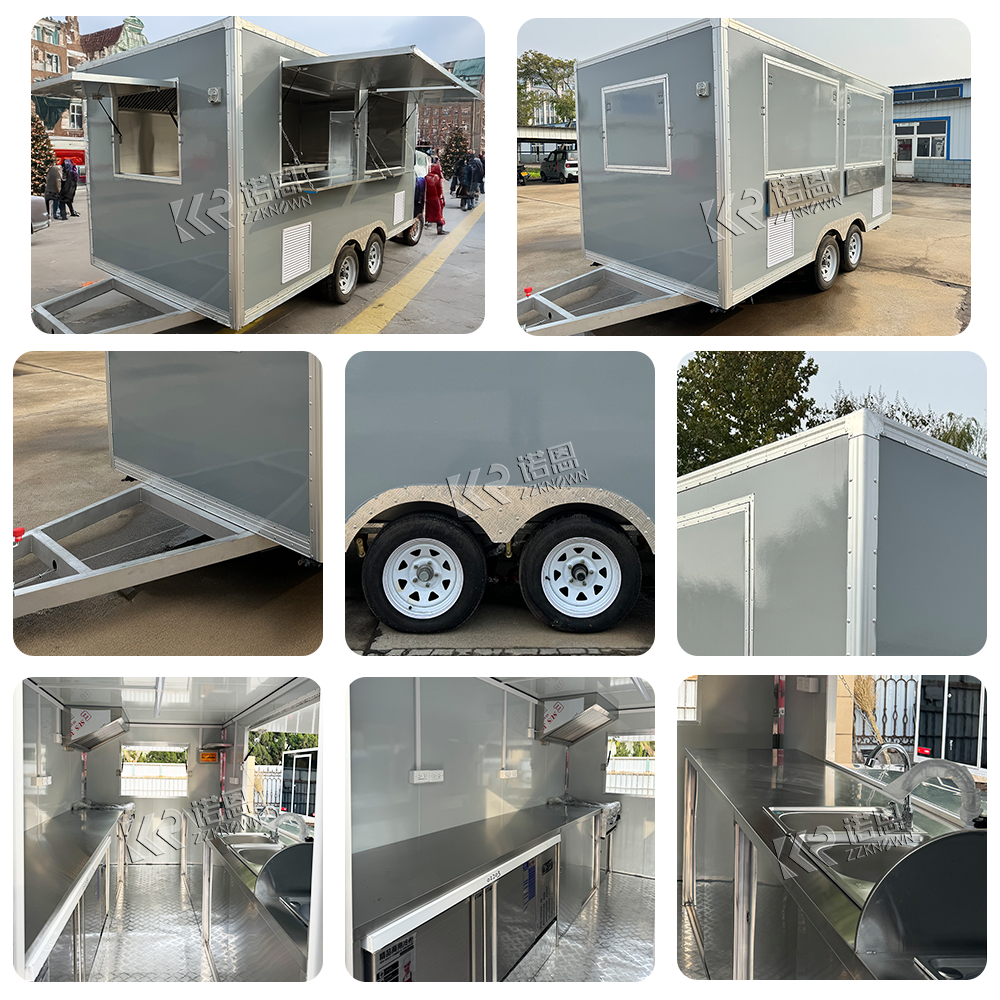
Real project image: a ZZKNOWN KN-FS400 interior. Sensor visibility and probe access should be reviewed with the equipment layout.
The ZZKNOWN KN-FS400 Mobile Burger Trailer combines a 1.8-meter refrigerated workbench with a gas fryer, gas griddle and exhaust system. That workflow needs a thin-tip probe for patties, a protected probe holder near the cook line, a fridge display away from direct heat and a clear cleaning routine between raw and cooked checks.
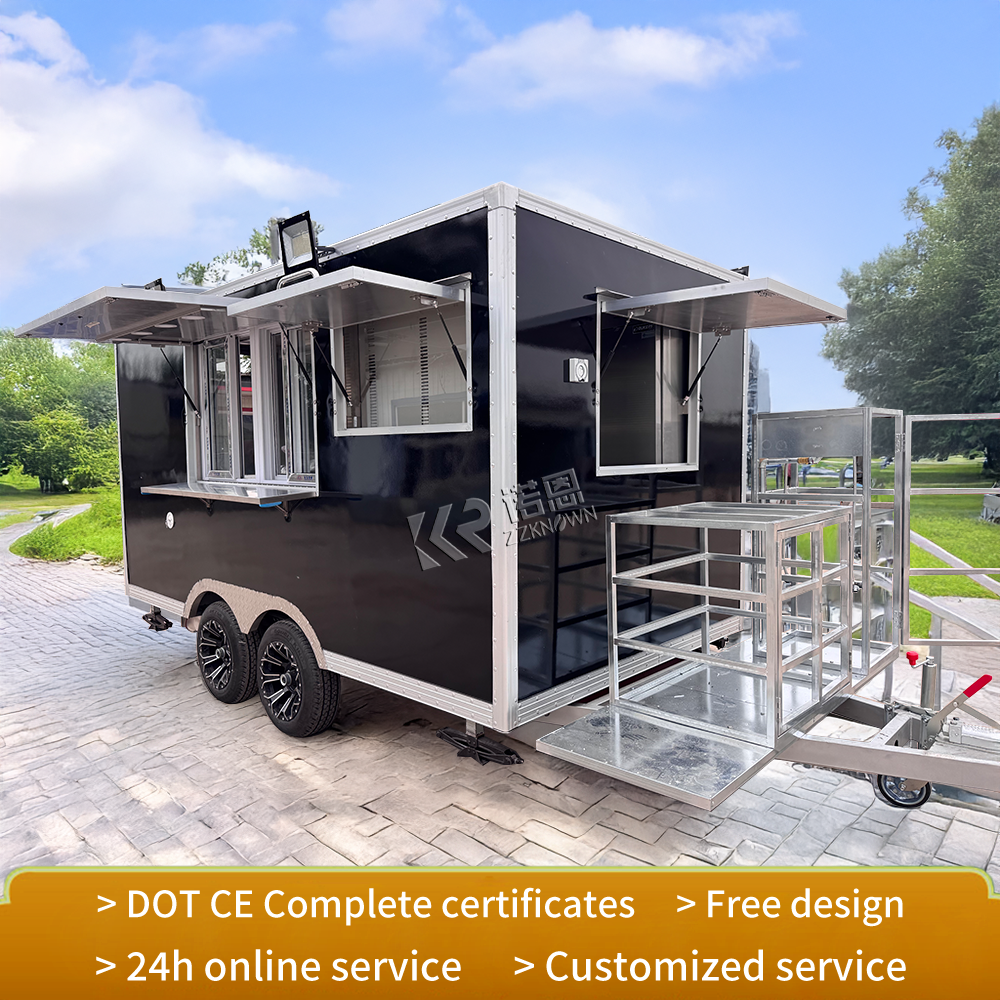
Real ZZKNOWN project image: an equipment-dense cooking line where thermometer placement must avoid heat, grease and workflow conflicts.
Refrigeration also adds electrical load and heat rejection. Coordinate the layout with our food trailer equipment power consumption guide and food trailer ventilation guide. A warm refrigerator may be an equipment, airflow, loading, door-gasket or ambient-temperature problem—not merely a thermometer problem.
We used four sources of evidence:
Official regulation and guidance: FDA Food Code 2022, EU Regulation (EC) No 852/2004, Australia Standard 3.2.2 / FSANZ guidance, USDA thermometer and cooking-temperature resources, and current CDC burden estimates.
Published product specifications: ZZKNOWN KN-FS400 event and burger trailer pages, including their refrigeration and cook-line configurations.
Engineering review: sensor visibility, equipment airflow, heat exposure, probe storage, electrical access and staff workflow were evaluated as layout decisions.
Buyer-use analysis: the article prioritizes questions that affect the quotation, CAD plan, inspection preparation and daily operating procedure.
We did not invent laboratory accuracy, universal inspection limits or guaranteed compliance. Device accuracy must come from the thermometer manufacturer; operating limits and records must come from the authority and food-safety process that apply to your business.
Many jurisdictions require or expect cold-holding equipment for temperature-controlled food to have a visible measuring device. The FDA model code calls for at least one integral or permanently affixed device in covered equipment. Confirm the rule locally, especially for small drawers, prep rails, freezers and display cases.
Use it for routine equipment monitoring, but verify actual food with an accurate probe. Ask where the built-in sensor is located. A display near the evaporator can look cold while product near the door is warmer.
A fast digital thermistor or thermocouple with a small-diameter tip is usually easiest. Insert it from the side into the center so the entire sensing area is inside the food. A long bimetal sensing zone may not fit a thin patty correctly.
Follow your local food-safety plan and manufacturer. Common trigger points include before first use, at planned intervals, after dropping the device, after extreme temperature exposure, after repair and whenever a reading seems wrong. Record the check and action.
Usually not for verifying internal food temperature. It reads surfaces. Keep an accurate probe available for the center of TCS/potentially hazardous food, and confirm what your inspector accepts for each task.
The food-contact portion should be cleaned and sanitized before and after use according to your approved procedure, especially when moving between raw and ready-to-eat food. Use chemicals at the correct concentration and contact time, and protect the electronics from immersion unless the device is rated for it.
Choose the scale used by your staff and authority. A dual-scale device helps international teams, but confirm it meets the accuracy requirement across the intended range. Make the log use the same primary unit to avoid conversion mistakes.
Send your menu, batch sizes, cooking equipment, refrigerator/freezer models, hot-holding equipment, operating country and city, expected climate, power supply and any local plan-review checklist. We can reserve visible sensor positions, probe storage and data-logger power before fabrication.
A thermometer costs little compared with a refrigeration unit, but its location can decide whether staff use it correctly. ZZKNOWN can review your equipment list and mark fixed displays, probe holders, data-logger sensors and logging points on the kitchen layout. We can also coordinate refrigeration clearance, electrical supply and ventilation so the temperature-control equipment can work as intended.
Send your menu, destination and appliance list. Our team will review refrigeration, hot holding, sensor visibility, probe storage and workflow before production.
Get a Quote and Free CAD Layout Review
Author: ZZKNOWN Editorial Team
Technical review: CNREALLY KNOWN Engineering Department
Review scope: thermometer terminology, sensor placement, refrigeration and hot-holding layout, published ZZKNOWN specifications and alignment with official sources.
U.S. FDA Food Code 2022, including sections 4-203.11, 4-203.12 and 4-204.112.
EU Regulation (EC) No 852/2004, Annex II, including temperature monitoring for mobile sales vehicles.
Food Standards Australia New Zealand—Thermometers and Standard 3.2.2.
USDA FSIS Food Thermometers guide and its safe internal temperature chart.
CDC Facts About Food Poisoning for current U.S. burden estimates.
Editorial note: Regulations, adopted code versions and product configurations can change. Confirm thermometer specifications, food-safety limits and inspection requirements with the authority at your operating location before ordering or opening.