Views: 6 Author: ZZKNOWN Editorial Team Publish Time: 12-11-2026 Origin: ZZKNOWN


Published: November 12, 2026 | Last Updated: November 12, 2026 | Reading Time: 15 minutes
Direct answer: An air gap is a visible break between an equipment drain and the receiving drain or vessel. It helps prevent backed-up wastewater from reaching equipment that holds food, ice, beverages or utensils. In a food trailer, the drain route must still reach an approved gray-water system without splashing or leaking. Which fixtures need an indirect connection, and the required gap, depend on the destination's adopted rules.
A drain is not just a pipe. A direct waste connection can create a path for wastewater to back up toward food-contact equipment.
Supply-side and waste-side air gaps are different. Do not copy the FDA's water-supply inlet measurement onto every equipment drain.
Draw every fixture separately. An ice maker, prep sink, three-compartment sink, hand sink and refrigerator may not share the same approved detail.
Protect the entire route. The gap must remain visible and above the receiving flood rim; the receiver, piping, gray-water tank and service point also need a cleanable, approved layout.
Get local review before fabrication. The U.S. FDA Food Code is a model, while local adoption and the destination authority control the project.
Scope and update: This is a global buyer's guide. We checked the U.S. FDA Food Code 2026, current Northern Nevada Public Health guidance, and the linked ZZKNOWN product pages on November 12, 2026. Dimensions quoted below are identified by source and jurisdiction; they are not worldwide rules.
Engineering boundary: This article is not a stamped plumbing plan or an inspection guarantee. A qualified local designer and the approving health or plumbing authority should review the exact trailer, menu and equipment schedule.
Picture a new coffee-and-dessert trailer at the end of a Saturday market. The ice maker has run all day, the prep sink has been used steadily, and the gray-water tank is nearly full. Someone notices that the drain hose from the ice maker disappears into a sealed fitting on the waste line. It looks tidy. But if that line backs up, where does the dirty water go?
That question is why a small open space in a plumbing drawing matters. Based on CNREALLY KNOWN's production experience, buyers often focus on tank size and sink count first. Those are important, but they do not tell you whether the drain from an ice bin, beverage station or food-preparation sink is protected from a wastewater backup. The useful question is not “Does the trailer have an air gap?” It is “Show me how each piece of equipment drains, where its indirect connection is, and how the waste reaches the tank.” That is a manufacturing-planning perspective, not a claim that a particular ZZKNOWN unit has passed a local inspection.
On the waste side, an air gap is an unobstructed vertical separation between the end of an equipment drain and the receiving fixture's flood-level rim. The pipe discharges into a hub drain, floor sink or another approved receptor instead of being hard-connected to the sewer or wastewater piping. If wastewater rises in the receiver, that physical break helps keep it from flowing back through the equipment drain.
The idea is simple enough to explain over a kitchen counter: the dirty side should not be able to push liquid back into the clean side. It is especially important where food, ice, beverages or utensils are placed. The FDA Food Code 2026, section 5-402.11(A) generally prohibits a direct connection between the sewage system and a drain from such equipment, with stated exceptions in paragraphs (B) through (D). Read those exceptions with the local authority; a sentence from the model code is not a complete plumbing design.
A common vocabulary trap is to call any short exposed drain an “air gap.” If a flexible tube hangs inside the receiver below the flood rim, the separation may disappear when the receiver backs up. If the tube can swing into a sink or become submerged, the drawing is not enough. Ask for the height measured from the drain outlet to the receptor rim, the method that keeps that height stable during road travel, and a detail of the receptor itself.
No. “Air gap” appears in two related but different conversations. A supply-side air gap protects drinking water at a faucet or water inlet. A waste-side air gap breaks the connection between an equipment discharge and the receiving wastewater system. Both resist backflow, but their measurement points and applicable provisions are not interchangeable.
Question | Supply-side gap | Waste-side indirect drain |
|---|---|---|
What is being protected? | Potable water supply | Food/utensil equipment from sewage backup |
Where is the break? | Water inlet to fixture flood-level rim | Equipment drain outlet to receiving rim |
What should the buyer ask? | Where is the supply opening and its backflow protection? | Which fixture needs indirect waste, and what is the approved receptor detail? |
Illustrative U.S. reference | FDA section 5-202.13 specifies at least twice the supply inlet diameter, never under 25 mm (1 in). | FDA section 5-402.11 controls direct connections; a local rule or plan reviewer sets the applicable receptor and gap detail. |
The supply-side figure comes directly from FDA Food Code 2026 section 5-202.13. It does not mean every equipment waste pipe worldwide must have a gap twice its diameter. Northern Nevada's retail construction guidance gives a separate, local example: certain equipment drains to a grease trap or floor sink need at least a 1-inch gap between discharge-pipe end and the topmost receiving rim. Use the destination's adopted requirement, not a number copied from a different side of the plumbing system.
Start with the menu and equipment schedule, then trace every line that can release water. Northern Nevada Public Health's air-gap public-health handout names ice machines and bins, refrigeration equipment, three-compartment and prep sinks, steam tables, dipper wells and beverage dispensers. This is a useful inspection-oriented checklist for a buyer, but it is a Nevada local example, not a blanket instruction for all countries or every model.
Ice makers and ice bins. Ice is food. Meltwater and the equipment drain should not provide a return path for wastewater. Ask where the ice-maker drain ends, whether the bin has a separate line, what receptor catches both, and how staff clean that receptor. The FDA Food Code also says liquid-waste drain lines may not pass through an ice machine or ice-storage bin (section 4-204.17).
Food-preparation sinks. A prep sink can hold produce or other food. It should not be treated as identical to a handwashing basin simply because both are stainless steel. Show its outlet, the receiving hub, any required trap/vent arrangement, and the path onward to the gray-water tank. The local reviewer should decide if an exception or different arrangement applies.
Three-compartment sinks. The drain from a warewashing setup involves utensils and food-contact surfaces. Ask how each bay discharges, whether the required indirect connection is accessible, and whether a shared receiver can handle peak simultaneous flow without splashing or backing up. Our three-compartment sink layout guide covers the work area; this guide focuses on the waste route underneath it.
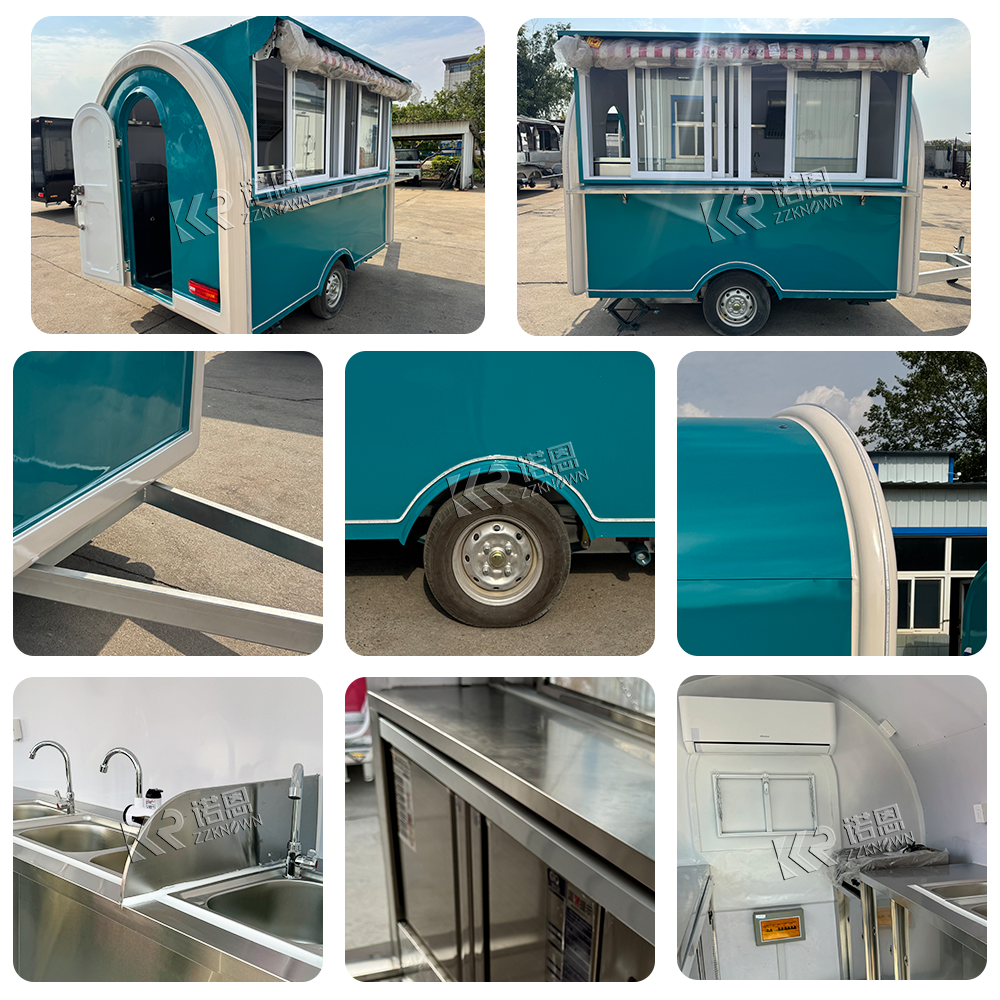
View the KN-FR280WH food trailer and sink layout →
Product-gallery photos show the trailer and sink context—not the drain termination or local inspection approval.
Refrigeration, steam tables and beverage equipment. These often generate condensate, meltwater or operational discharge. Ask for the exact manufacturer's drain instructions; not every unit has the same outlet or expected flow. A coffee machine may have multiple waste streams. An ice bin may sit beside a refrigerator but need a separate route. If an appliance has no drain, do not invent one just to match a generic diagram.
Handwashing sinks. Hand sinks have a different purpose and may be treated differently under an adopted code. Northern Nevada's inspection field guide says hand and mop sinks are the only equipment types there that may be directly plumbed without a drain air gap. That is local guidance, not permission to use direct connections everywhere. See our handwash-sink placement guide for separation and splash issues.
Illustrative workflow—not a construction drawing
Ice maker / prep sink / approved equipment outlet
↓ separate drain line
Visible, secured discharge above receiver rim
↓ air gap / indirect waste connection
Accessible hub drain or other approved receptor
↓ properly designed waste piping
Gray-water retention tank → shut-off valve → approved servicing area
This simple chain is more useful than a photo of a gray-water tank alone. It forces the designer to answer the uncomfortable questions: What happens if the receptor clogs? Can a technician see the gap? Is the receiving vessel large enough for simultaneous discharge? Where does a splash land? Can staff clean it without crawling behind a freezer? Does the line have a route that survives trailer vibration and road movement?
Do not assume the receiver may be an open bucket under a counter. A bucket can spill during travel, create an odor source and leave the disposal route unresolved. The receiving point should be part of the approved plumbing and wastewater design. The FDA's 2026 model Food Code sections 5-402.13–15 address approved conveyance, removal and sanitary flushing of mobile-unit waste. Local rules may add requirements for the service area, grease management and tank access.
A tube pushed below the receptor rim: a blockage can submerge the outlet and defeat the visible separation.
A loose hose: it can fall into the receiver after a long drive, even if the installation photo looked correct.
A tiny or poorly located receptor: peak flow splashes onto stored food, electrical equipment or the floor.
Multiple drains without a flow check: an ice maker and sink can discharge together, overwhelming a receiver sized by eye.
Hidden joints: a leak behind a fixed cabinet may go unnoticed until an odor or floor stain appears.
Confusing air gap with tank capacity: a larger gray-water tank does not prevent backflow at an improperly connected appliance.
Copying a U.S. detail into another market: approval depends on the destination's code, equipment instructions and local inspector.
These are design review points, not allegations about a specific manufacturer's trailer. They are easiest and cheapest to discuss while the CAD layout can still change. Once counters, refrigeration and tanks are installed, moving a receiver may mean cutting panels, rerouting pipes and losing valuable storage space.
The published KN-FR280WH 2.8 m snack trailer is a useful planning example. Its product page lists a 3+1 sink system, two clean-water tanks of 75 L and 30 L, a 130 L waste tank and a refrigerated prep table. That tells a buyer which components need a coordinated water-and-waste drawing. It does not show the precise drain termination for each sink or refrigeration unit, and it does not establish inspection approval in the buyer's city.
If you are considering an ice-producing operation, the listed KN-SN200 snow-ice machine provides another real equipment reference. Its page lists 200 kg/24 h nominal snow production and a 900 W electrical rating. Neither figure tells you its installed drain configuration inside a specific trailer. Ask for the appliance manual and a project drawing showing the ice equipment's actual wastewater connection.
For a fuller picture, look at the kitchen inside a trailer rather than an appliance alone. The ZZKNOWN 4 m event food trailer product page shows stainless work areas, a sink and the under-counter water-system space. These photos help you discuss where equipment and service access might go; they do not show a verified air-gap installation.

Explore the 4 m event food trailer kitchen →
Interior product photos for layout discussion. Ask for a project-specific drain drawing and local approval before production.
Use the real KN-FR280WH product gallery to see the trailer's space and equipment context. Product photos are not close-up proof of an air-gap installation. For a purchase decision, request a current project photo of the receiver, the corresponding drawing and the installed equipment schedule together. We do not substitute an AI illustration for that evidence.
Ask for a single coordinated plumbing package, not a generic specification saying “water system included.” It should identify your destination and menu, list every water-using appliance, and show which lines supply drinking water and which carry wastewater. At minimum, ask for:
A fixture-by-fixture schedule: model, sink or appliance use, water demand, drain outlet and manufacturer instructions.
A plan view and elevation: each drain route, receiver position, vertical air-gap detail where required, gray-water tank and service point.
A receiver detail: flood-level rim, secure drain termination, splash management, access for cleaning and expected simultaneous flow.
A water-system separation detail: potable inlet, backflow protection, clean-water tank, pump and dedicated waste route.
A waste-service plan: tank capacity, shut-off valve, hose connection and approved place to empty the unit.
An approval checklist: which drawing will be reviewed by the local health/plumbing authority before fabrication and which items need field verification after delivery.
Make the supplier answer in drawings and photos. A quotation can say “air gap available,” but without a fixture schedule you cannot tell whether the gap is planned for the ice bin, prep sink, refrigerator or all three. Likewise, a one-inch measurement on a brochure is not enough if the discharge tube can move or the receptor rim is not shown.
Source | What it says here | Buyer caution |
|---|---|---|
Section 5-402.11 generally bars direct sewage connections from food/utensil equipment, with exceptions. Section 5-202.13 gives a separate supply-inlet air-gap measurement. | U.S. model code; check adopted local edition and amendments. | |
Names equipment types for which indirect wastewater connections matter. | Washoe County, Nevada public-health guidance, not global law. | |
Gives a local 1-inch equipment-drain gap example measured to the receiving vessel rim. | Confirm the current posted version and project-specific interpretation with NNPH. |
For a buyer in Australia, Europe, the Middle East or elsewhere, these sources explain the engineering hazard but do not replace local plumbing, food-safety and vehicle requirements. Send the destination authority's checklist to the manufacturer early. The right question is not whether the factory can copy a Nevada drawing. It is whether the proposed layout can be reviewed and adapted for the place where the trailer will actually operate.
ZZKNOWN's editorial team reviewed the FDA Food Code 2026 sections on supply-side air gaps, direct waste connections, ice-unit drains and mobile waste handling. We compared those model-code provisions with Northern Nevada Public Health's current air-gap handout, construction guidance and mobile-unit resources. We then checked live ZZKNOWN product pages for the KN-FR280WH and KN-SN200 specifications and turned the technical requirements into buyer questions. We did not physically inspect a finished unit, measure a built gap or claim certification for an individual project.
Author: ZZKNOWN Editorial Team. Technical review: A destination-qualified plumbing designer and the relevant approving authority should review the project-specific drawing before production. No named engineer's sign-off is claimed for this general article. Image disclosure: The title illustration is AI-generated and is not a customer-project photo or approved plumbing diagram.
Ice equipment deserves a fixture-specific review because ice is food and the drain must not create a sewage-backup path. Northern Nevada expressly lists ice machines and bins in its air-gap handout. Confirm the adopted rule and the machine maker's instructions for your location.
No. Northern Nevada uses a one-inch equipment-drain example in its local guidance, while the FDA's twice-diameter/minimum-one-inch provision is for a water-supply inlet. Do not confuse these measurements. Ask your local authority to approve the actual waste-side detail.
Do not assume a sealed direct connection is acceptable. The FDA model generally bars a direct sewage connection from equipment in which food is placed, subject to specific exceptions. A project designer should show the approved indirect receptor and route to the tank.
No. A handwashing sink, food-preparation sink and warewashing sink have different functions. The adopted code may treat them differently. Label each sink on the drawing and ask for a separate drain decision.
Do not design around an unsecured bucket unless the local authority explicitly approves that arrangement. The receiver needs to handle flow, cleaning, splashing and travel safely, and wastewater must continue to an approved tank or disposal system.
That is a design or maintenance problem, not a reason to remove the gap. Review simultaneous discharge, pipe sizing, blockage risk, access and tank capacity. Stop using affected equipment if wastewater threatens food or food-contact surfaces, and correct the cause.
Sometimes, but retrofitting may require moving a sink, equipment, cabinetry or tank line. It is usually easier to identify the receiver and drain heights in the CAD stage. Any field change should be reviewed against the local approval.
Send your destination city and country, menu, trailer size, sink list, equipment model numbers, manufacturer manuals if available, expected operating hours and local plan-review checklist. Ask for a marked plumbing drawing, not a generic promise that the trailer is “inspection ready.”
Send ZZKNOWN your menu, destination and equipment list. Ask us to mark the potable-water inlet, tank, pump, sinks, equipment drains, indirect connections, gray-water tank and service outlet on one coordinated layout—then have your local reviewer confirm it.